One of the stylistic rules we have here is that we are discouraged from using the word “icon”. It’s used too casually these days, goes the thinking, too grandly, too glibly, too often. All of which is true. But since Tate Modern has called its Frida Kahlo show The Making of an Icon it cannot, in this instance, be avoided. Besides, if anyone can get away with being described as an icon, it’s surely Frida Kahlo (1907-54).
There’s a photo in the catalogue of something called Frida Fest, held at the Dallas Museum of Art in 2017. People were asked to turn up looking like her and thousands did: a river of fans in shawls, braids and flower dresses; fat, thin, tall, short, old, young, all trying desperately to resemble the imaginary Frida. It’s a frightening sight.
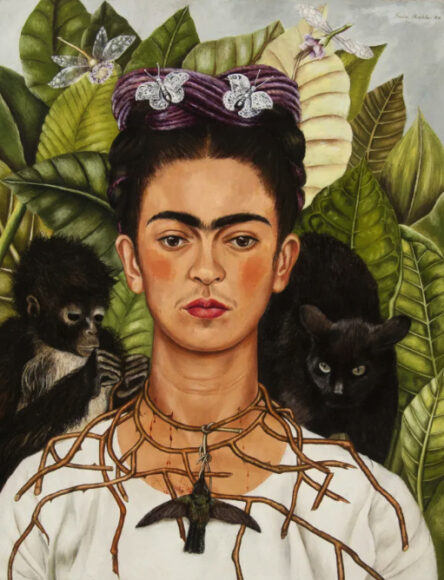
The photo is not in the show, thank Quetzalcoatl, but, ghastly though it is, you could not ask for a clearer illustration of the issue the Tate is seeking here to address: how and why did an obscure female artist from Mexico, of whom few had heard when she was alive, turn into the monstrously sized cultural phenomenon that is Frida Kahlo today?
The effort to answer that question takes two shows pretending to be one. The first is mostly about Kahlo and tries, in a jumbled manner, to understand the things in her artistic make-up that would lead to her popularity. The second unveils the fruits of that popularity. Unfortunately.
It’s horrible stuff and soon sets some sort of world record for narcissistic me, me, meing in the fields of gender flexibility, feminist politics, the search for identity, disability art, gay art and postcolonial payback. Huge paintings in gaudy colours by a jostling crowd of Ancient Mariners determined to grab you by the lapel and tell you their story overcrowd the walls. Forgive me if I leave them to their noisy self-interest and concentrate on part one.
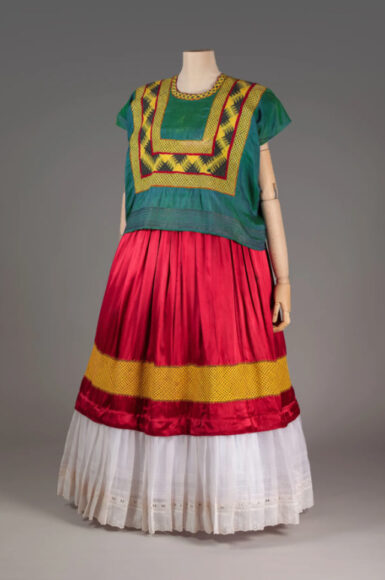
As soon as you walk in, it’s obvious that this is not just an art show. In the distance a row of colourful dresses of the kind that Mexican women wear in early Clint Eastwood films frames the vista.
In the middle of the room there’s the spooky corset Kahlo used to support her broken back when she was in hospital in 1950, the one on which she painted a hammer and sickle and a baby foetus. And just look at the size of the opening photo of her. Tall as the wall, it shows her holding up a picture frame round her face: Frida defining herself instinctively and instructively as Frida.
Scattered among these iconic sights is a smattering of paintings from the start of her career. They do not yet feature the thrilling mix of fierce self-portraiture and heartbreaking symbolism that distinguishes the mature Kahlo, but most are able already to tug the tears out of your eyes.
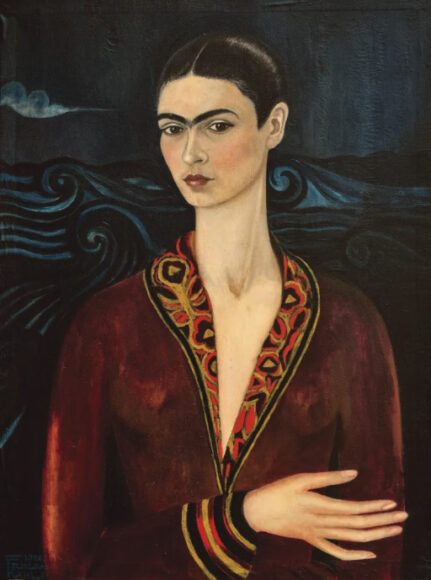
Their focus is the horrible accident she had when she was 18, when her back was broken and her legs mangled by a tram. She describes it in a drawing and re-enacts it with some toys in a spooky photograph. Then, in an effort to move on from it, and to please and entice her boyfriend at the time, she paints her first self-portrait, Frida in a velvet dress, where she makes herself tall and mysterious like a mannerist Sibyl in a painting by Parmigianino.
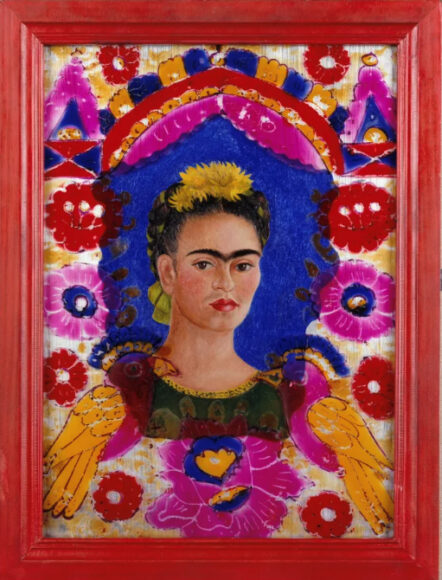
The Tate is right to position the accident this prominently in her story. Not just because it prepares us so well for the torrent of bad art ahead when she becomes the patron saint of artistic disability, but because it convincingly explains the turning inwards that becomes her method. Cut off from the outside, she’s forced to dwell on the inside.
Also prominent in the show’s opening burst is the love affair with the painter Diego Rivera, whom she married twice. It’s been the subject of such crass reduction, notably in the awful film in which Salma Hayek pretended to be Kahlo, that we have lost sight of its true flavour. Here we feel its warmth again in the lovey-dovey double portrait she painted in 1944 where the two of them are joined together like the shell of a clam: two parts of one whole.
The show has about thirty paintings by her, which, given how many huge Tate rooms it occupies and how much other stuff there is here by followers and contemporaries, may feel like a shortfall to some. But one of the deeper pleasures of this journey is seeing how convincingly Kahlo stands up to her surroundings. Outnumbered, outsized, outshrilled, outshouted, out-me, me, me’d by her battalions of followers, there’s an elegance and gravity to her work that none of the acolytes can match. The organisers have sprinkled her lightly about part two as well. Hallelujah. In every instance she saves the day.
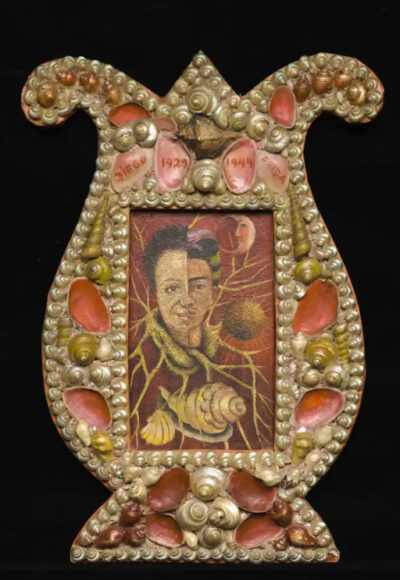
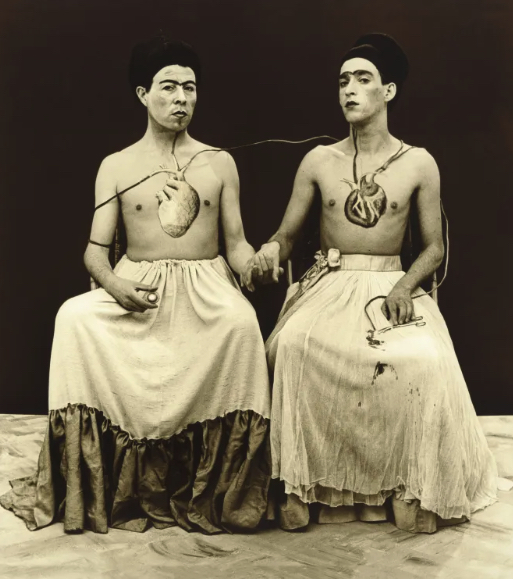
The show’s best room examines her relationship to surrealism. It’s the best room because it consists solely of her art. What you witness here more easily is how much space she leaves in her meanings for other imaginations to fill in: how she enfranchises her audience.
It’s the reason her work is as good as it is. But it’s also the reason why such a huge crowd of stiff-wristed international navel-gazers from every sweaty interstitial corner of modern life has been encouraged to follow her.
That’s her unwanted epitaph: Frida Kahlo awakened the me monster.
Frida: The Making of an Icon is at Tate Modern, London, to Jan 3