There’s a sense with some artists that their careers fell between the cracks. They lived in times of momentous change, but where they fit into that change is unclear. Toulouse-Lautrec was such an artist. Edvard Munch another. And so, certainly, was James Abbott McNeill Whistler.
On every front, Whistler (1834-1903) feels interstitial. His dates correspond with Cézanne’s, but his style could be earlier, or later. Born in Massachusetts, he grew up in St Petersburg, trained in Paris, settled in London. He’s known for twilit water scenes, but they were painted indoors. “Painting from nature”, Whistler wrote, “needs to be done at home.”
This imprecision is both his calling card and the reason why shows like Tate Britain’s meandering attempt to firm him up have their work cut out. Making clear the achievements of Whistler is like trying to make bullets out of mercury.
The Tate attempt begins randomly with a dip into his taste for eastern art. A room of the kind he might have lived and worked in is evoked loosely with Chinese pots from his collection, a reproduction of a screen he made jointly with a Japanese artist — she made one side, he made the other — and a row of fake windows. What’s solid and what isn’t is firmly unclear.
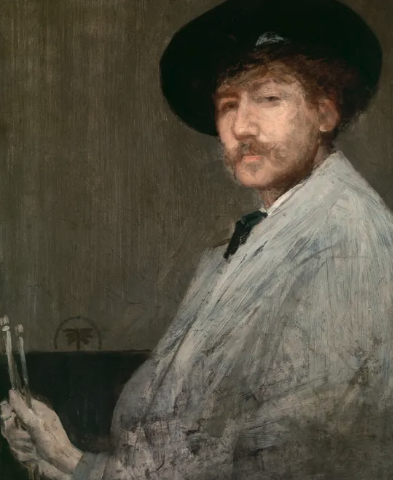
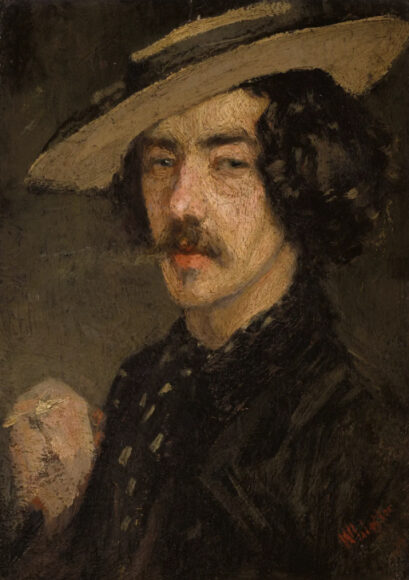
What does become rapidly obvious is that he was a cocky so-and-so, insufferably pretentious, besotted with appearance. With his monocle, his affected southern drawl, his taste in silly straw hats (see the self-portraits), he was the kind of guy you want instinctively to punch in the nose. And many did.
But — and it’s a huge but — the screaming egotism gave him the drive to become genuinely progressive in his art. It’s the show’s unexpected message. Whistler was a much more revolutionary presence than we generally assume. The history books have not given him his due. He’s been underestimated.
That said, his beginnings were shaky. The first drawings, done in St Petersburg when he was in his early teens (his dad was building Russia’s first big railway for a tsar), are stiff even by the standards of early teens. But the family had money, so they sent him off to Paris to study and he joined in enthusiastically with what he imagined to be the true artistic life.
A French girl called Fumette, because she chain-smoked, became his first bohemian mistress (ie first female victim) and pops up in assorted states of dress and undress as Whistler, inspired by Rembrandt, makes etching his primary means of expression.
Let’s be clear here — he’s no Rembrandt. As an etcher, his touch is whispery, fidgety, often brave, but it lacks the profound sense of humanity that Rembrandt brought to his art. With Rembrandt you’re listening to a pounding heart. With Whistler you’re watching a twitchy wrist.
But — and it’s another big one — the lessons he imbibes from Rembrandt the etcher become transformative when he takes up painting. The show keeps drawing our attention to his “taches”, the French word for stains, which in art has come to mean something like “loose marks”. In etching, the artist has to find a visual shorthand, an assortment of marks, to convey the appearance of things. Those marks are rarely predictable. When Whistler becomes a painter, he takes the same approach, and his mark-making becomes startlingly inventive.
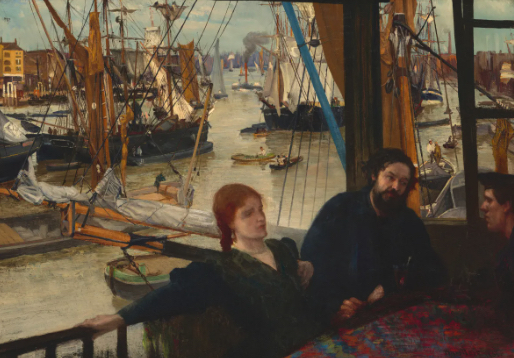
The best evidence of these imaginative reductions is in his views of the Thames, subfusc suggestions of the river at Battersea or Chelsea where he sets himself the challenge of saying a lot with a little. River currents become loose scratches of paint. Dribbles and smudges become skylines. The colours, too, are reduced: pale grey, shadowy black, foggy blue. What Japanese calligraphy is to writing, Whistler’s Thames views, his celebrated Nocturnes, are to landscape.
At the same time, his portrayals of mistresses and loved ones borrow the poetic moods and stylised poses of Japanese geisha pictures. They’re not really portraits. They’re evocations: pre-Raphaelite atmospheres achieved with a deliberate absence of pre-Raphaelite detail.
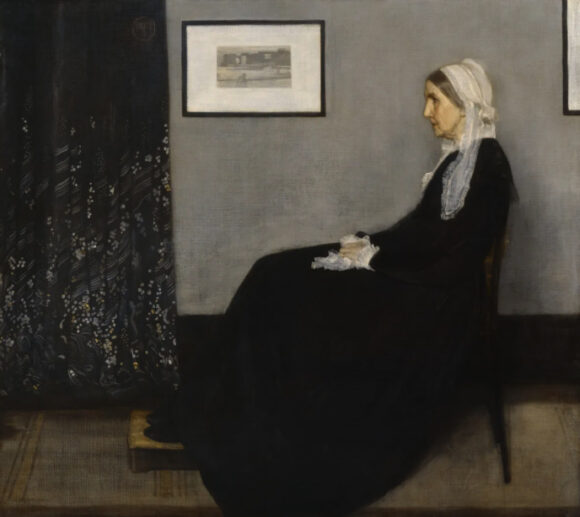
The Little White Girl shows his lover Joanna Hiffernan in cascades of white, leaning on a white mantelpiece, surrounded by pale pink flowers, as if she too were an exquisite example of ikebana. In the show’s most famous picture, his grey-and-white mother sits sideways in the stern Egyptian style to rhyme as closely as possible with her grey-and-white surroundings.
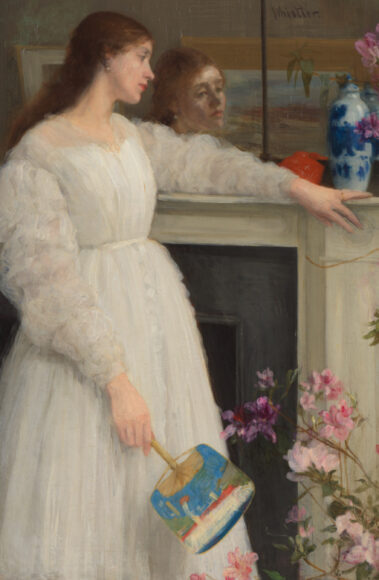
The results feel a mite too stagey until you notice the dates on which the pictures were made. The first Thames Nocturnes are from 1863. Joanna Hiffernan is The Little White Girl in 1864. That’s a full decade before the first impressionist exhibition of 1874 and dazzlingly early to be making pictures this adventurous, this loose, this reliant on flicky paintwork and, yes, this impressionist.
Invited to show with Monet and co, Whistler declined. His vanity precluded any artistic sharing. As a result, no one thinks of him as the crucial and pioneering impressionist he most definitely was.
The show tries manfully to keep up with these twisty events. Taking its cue from Whistler’s love of artifice, it includes a full-scale mock-up of his Peacock Room, fills its gaps with high-quality reproductions, and even has someone dressed up as Whistler delivering his “Ten O’Clock” lecture with a southern drawl in a noisy video.
It’s a bitty journey. With lots of detours. But most of his best work is here. There are plenty of Nocturnes. The story feels reliable. And the key point — how revolutionary he really was — is unmissable.
James McNeill Whistler is at Tate Britain, London, to Sep 27