Idon’t know as much about Freudian meanings as Anish Kapoor. He’s spent several decades being psychoanalysed, whereas I read Sigmund Freud’s Civilisation and Its Discontents many moons ago. But I have spent enough time in the art world to have picked up some basics.
So I know that we have ids and we have egos, and that the egos control the sensible stuff while the ids control the wild bits. Armed with that knowledge I know as well that Kapoor’s extraordinary exhibition at the Hayward Gallery is attempting a tango danced simultaneously by the two of them. Strictly Come Freuding! Quick, quick/slow, slow. Solid, solid/empty, empty. Sensible, sensible/loony, loony.
A psychoanalyst sent to review this event would be a pig in clover. For a mere art critic, it’s often foreign soil. Knowing a lot about impressionism or Michelangelo or Andy Warhol is zero help when you are standing before a gigantic bucket of glistening guts, slithery with blood, that appears to have come from the inside of an elephant. Or staring into a perfectly round mirror that tips you sideways and upwards at optical angles that stretch the mind. “Mum,” you feel like sobbing, “a bad man is fiddling with my brain. Help.”
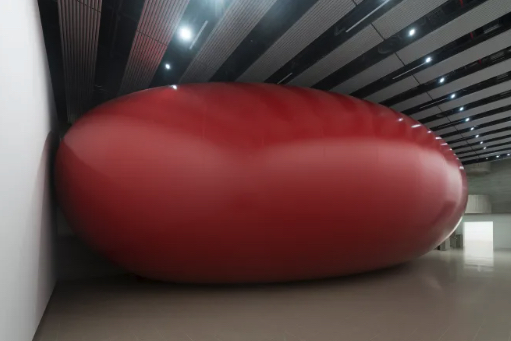
Not that the attacks on your innards are always successful. The show actually starts weakly with what ought to be one of its best moments. As you walk into the Hayward’s opening space you are confronted by a gigantic blob of shiny stuff coloured a dark and organic red. Imagine a liver 60ft long. The livery blob fills nine tenths of the space and leaves you just enough room to wander along its edge.
If you know the painting by René Magritte in which an enormous apple fills a tiny room you’ll know the effect Kapoor is intending to achieve. He’s trying to make you feel small, crushed, pushed against the wall. The livery blob could be a giant meteorite that’s crashed through the roof. It could be a human organ grown to a monstrous size like one of those prize marrows you see up north. It could and should be frightening. Alas, it’s quickly evident that it’s basically a blown-up balloon. What ought to be crushing and threatening is just a bouncy castle.
So that’s his opening attempt to shake your id. In the next gallery he goes for the ego. This time the space is dazzlingly, beautifully, cleanly white. It’s like walking into a toothpaste ad. White, white everywhere. Except in the precise patches of darkness that are the room’s chief sculptural concern.
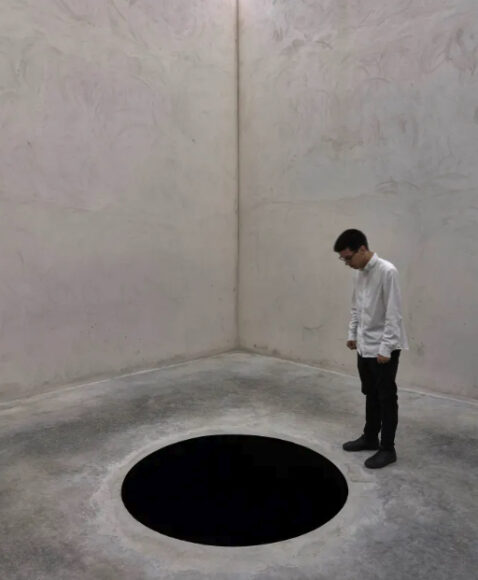
Most of the darknesses are geometric in shape — circles, ovals, rectangles. Some are more organic — a fissure, a vagina. What’s incessantly puzzling about them is that you don’t know if they have been painted on top of the white — flicks of black ink on an empty page; dirty footprints on a pristine floor — or if they are openings. Cracks in the white leading to pitch black interiors.
We never really find out. Not conclusively. Not one of the dozen or so sculptures that make up this fabulously tricky ensemble fully reveals its reality. One has you staring down at what appears to be the entrance to a cosmic sinkhole that never ends. Another has you staring at a dark doorway unsure if the door is open or closed. What you presume to be a flat wall turns out to protrude gently like a perfect minimalist breast. “Mum, can I have some milk? The bad man is making me dizzy. And I don’t know where to stand.”
Thus this unstoppably visceral event keeps trying to catch you unawares. On paper it’s an art show; in the flesh it’s aesthetic circuit training. And one thing that needs to be said immediately about it is that few artists, if any, have attacked these awkward Hayward spaces with as much ambition and vim as Kapoor. In the battle between artists and the Hayward, the gallery is almost always the winner. Not this time.
He’s really good at bigness. Size is one of his most potent sculptural tools. And because he’s 72 and has been round the block more times than Lewis Hamilton racing in Monaco, he knows and proves that the best way to beat the Hayward is to out-size it. Command the spaces. Don’t let them command you.
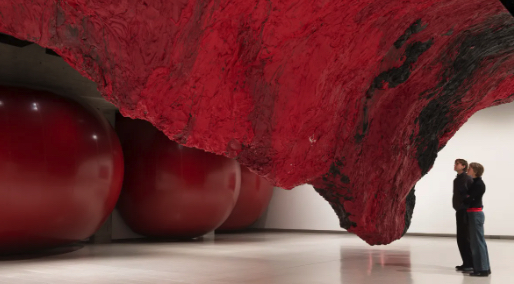
So you walk into one gallery and what appears to be the entire pinnacle of a mountain is protruding through the ceiling. Where to stand? It crowds you. In the colonnade behind, more of the livery blow-ups from the first room have squeezed into the openings and feel as if they are enlarging in your direction. They still have something of the bouncy castle about them. But now they feel threatening in a Doctor Who way. “Mum. Where’s the exit?”
It’s good stuff and, unusually, it gets better as you climb the Hayward. The enormous top floor here has successfully martyred 99 per cent of the artists who blunder across it. But it can’t get Kapoor.
In a fabulous display of sculptural arrogance he fills the biggest gallery with what appears to be an enormous slab of Australia, a quivering red landscape on which some ancient civilisation based near Uluru has left an opening that could once have been the entrance to a sacred shrine.
No, wait. Maybe it isn’t Australia. Maybe it’s the moon. Somewhere down in Hell, Sigmund Freud will be marking this show and giving it nine out of ten for chutzpah.
Anish Kapoor, at the Hayward Gallery, until Oct 18