There have been many dewy-eyed tributes to David Hockney since his passing on Thursday. Many of us have been moistly remembering the sheer pleasure of spending time with Britain’s most popular artist. The cheeky comments, the naughty stories, the clever insights.
I can hear him in my ears right now, his singalong Yorkshire brogue time-stamped to the Fifties. When Hockney opened his mouth he transported us to a Britain that was warmer, safer, nicer. No wonder everyone loved him. Sonically, he was irresistible.
His art, too, had something effortlessly pleasing about it. It looked modern, but never so modern that you couldn’t understand it or that it frightened you with obscure agendas. He painted trees, flowers, people. Stuff we all paint as kids. His favourite colours were the cheery colours the teacher might hand you in a nursery. Hockney didn’t just speak human, he spoke a dialect that was especially friendly, especially charming. Or rather — and it’s a very big or — he appeared to.
One of his favourite art locations was China. He loved Chinese scrolls, Chinese landscape art. If he was still with us, because he was so well read, he could probably come up with exactly the right Chinese wisdom to warn us against the easy acceptance of what we see. Something like: “The clever cricket does not mistake a tiger for a lamb.”
The fact is, as we sit here remembering the charm of David Hockney, we are remembering the wrong artist. In truth he was always something pricklier: a revolutionary. As they might say in India, somewhere else he was fond of, Che Guevara had dressed up as Gandhi.
So what was he really up to? Initially his agenda was as social as it was artistic. As a gay man born into working-class conservatism in rainy Yorkshire, he had a fierce appetite for alternatives. Every time Hockney the colourist reached for one of his lemon yellows or a Californian blue he was expressing a passion to leave behind the damp greyness into which he was born.
Being gay in the years of his artistic youth wasn’t just a crime, it was a huge social no-no. The first paintings he produced when he escaped to London in 1959, to the Royal College of Art, are packed with a gay coding worthy of Bletchley Park.
The masterpiece from his earliest phase, We Two Boys Together Clinging, from 1961, shows two hugging blobs, inspired by the blobby French art of Jean Dubuffet, flavour of the month at the time.
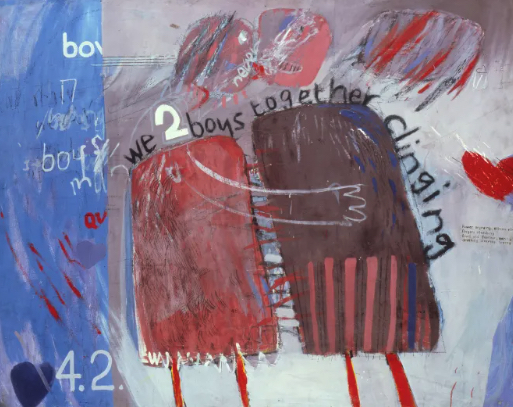
The painting’s true story is revealed in the numbers scattered about the corners. The big digits, 4.2, are letter code for D and B, indicating Doll Boy, which stands for Cliff Richard, whose big hit Living Doll had made him a gay icon. The 4.8 is Hockney. The 16.3 is Peter Crutch, a fellow student whom he fancied.
Every time I see this charged early art I’m tempted to view it as Hockney’s best work. The messy expressionism feels in tune with the era’s true mood. The societal fight is such a crucial fight. He may not be Francis Bacon, but in his first art Hockney appears to be channelling the angers of his century. So what does he do? He leaves.
The departure for Los Angeles in 1964 was his second great escape. When he moved to California he swapped a pint of tepid Yorkshire bitter for a sparkling cocktail of cars, sunshine, swimming pools, relaxed lifestyles and pretty boys. It was as if all the darkness had been ejected into the Atlantic on the flight over.
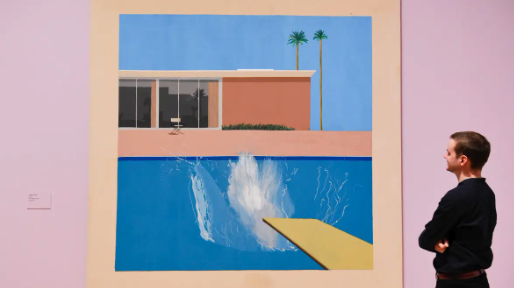
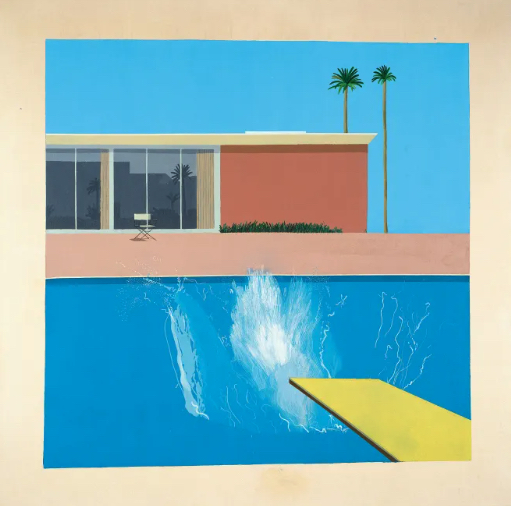
I first met him at his home on Mulholland Drive, high up in the Hollywood Hills, in 1987. He was celebrating his 50th birthday. Most of his California years were behind him. He’d long ago painted A Bigger Splash, the iconic swimming pool ejaculation from 1967 in which he’d celebrated gay sex without mentioning gay sex.
His house was exactly like one of his LA paintings. Tidy. Brightly coloured. Clearly outlined. At its centre was the swimming pool, beckoning irresistibly with its pure blue waters, to which he’d added abstract marks on the tiling that made it look like a pool in one of his pictures. The real swimming pool was coded to look more like a painted one.
That’s when I realised how twisty and revolutionary his mark-making actually was. Here we all were assuming the art was about the boys and the sunshine when actually it was about how best to depict the boys and the sunshine.
At the time he was working on another of his LA enthusiasms: the opera. He’d been commissioned to design the sets for Wagner’s Tristram and Isolde at the Los Angeles Music Center. The model for his sets was in the studio. He showed it to me proudly.
The interesting thing was he was already going deaf. As he described his sets for Wagner, he simultaneously lamented how he could no longer hear the music. On a crucial level, the opera sets were feats of memory. Visual codes again.
Another of his phases involved giving up painting and focusing on photography. He’d invented a new style of cubist photograph, which involved taking hundreds of small snaps, then re-assembling them in a big picture. The idea was that this cubist photography was more truthful than the single-view approach. The camera always lied, especially in matters of perspective. So an experienced code-breaker was deconstructing other codes.
Once the genie of technology escaped from his lamp there was no forcing it back. Having done photography he set about experimenting with pretty much every technical aid available to art. In the Nineties he began to take an interest in the way the old masters achieved their truthful effects. The code-breaker was onto the older coders.
The results appeared in 2001 in his book Secret Knowledge, in which he announced a revolutionary understanding of the way the old masters used optical aids — the camera obscura, the camera lucida — to achieve their effects of reality. Art historians were appalled.
Hockney, the yell went up, was accusing the old masters of cheating. But he wasn’t. He was cracking their codes.
When the evident joys of California begin to feel shallow and, perhaps, dishonest, he returned to Europe, initially and surprisingly to Yorkshire where the changing of the seasons brought him pleasures he had forgotten. The trees. The fields. The fogs. His return to Yorkshire inspired such warm art.
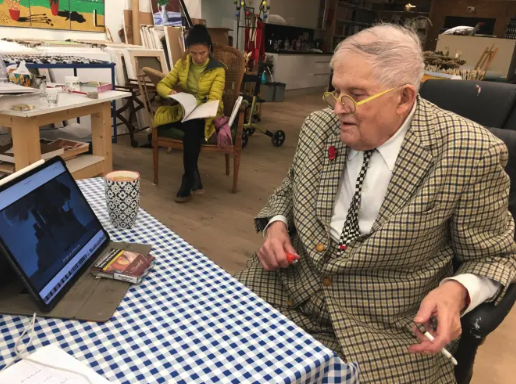
He was in his seventies. Emotionally, you felt, he had returned home for the end. Artistically, though, he was incapable of slowing down — the iPad drawings, the videos, the multi-screen evocation of the changing seasons. So what does he do? He leaves again. For one last foreign hurrah. Moving to a delightful cottage in Normandy, he escaped the bossy people in Britain telling him to stop smoking.
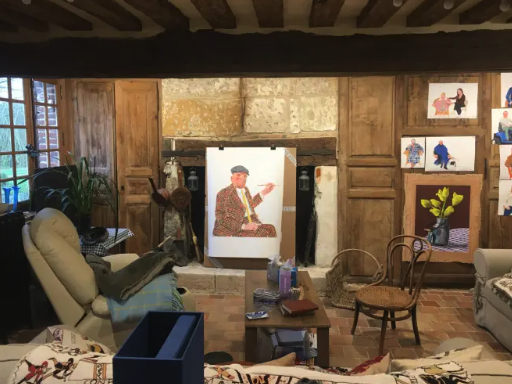
I visited him there during one of the Covid breaks and was astounded by the amount of art he was producing: landscapes, flower paintings, portraits. He’d turned into a factory churning out David Hockneys. At lunch, he asked, entre nous, if I would eat the naughty foie gras his housekeeper had prepared. You bet I would!
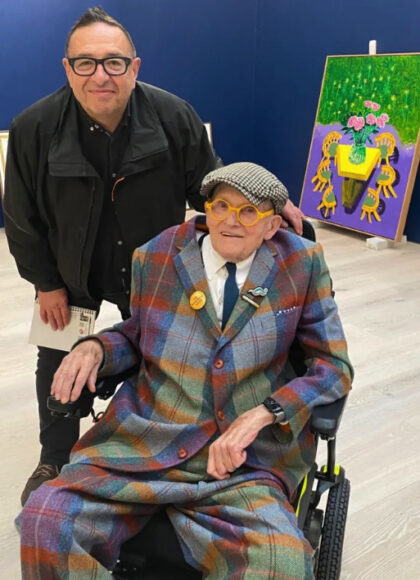
The last time I saw him he’d moved back to London. Normandy was idyllic but the hospitals were far away. I’d noticed in France that his hand shook occasionally. The precision with which everything in the studio was set out — the paints, the canvases — wasn’t just an aesthetic choice. It made things easier too.
In London the King had just been to see him. But no, he wasn’t going to paint him. I asked him once why he had never painted the late Queen. “Because I didn’t know her,” he replied, with that irresistible Yorkshire truthfulness.
He turned down knighthoods. For decades he refused to have anything to do with the Royal Academy. When they told him to stop smoking he brought out a badge saying “End Bossiness Soon”. For better, for worse, in sickness and in health, Hockney was always a naysayer. That’s the charming revolutionary we need to remember.