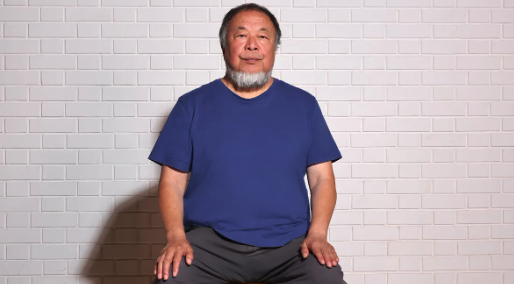
Ai Weiwei doesn’t recognise me. But I recognise him instantly. He’s fuller round the tummy and the snows have fallen on his head, but the big giveaway is the trademark calm he exudes. A volcano could erupt at his feet, Chairman Mao could walk into the room and announce “I’m back!”, and China’s most celebrated dissident would still finish his sentence. He’s like one of those implacable Chinese scholar’s rocks you see in museums.
In July Mr Implacable will be opening a selection of his work in Manchester in a show that is being billed as his biggest. That really is saying something. Not only is he China’s most celebrated dissident, whose recurring run-ins with the state feel like a game of “She loves me, she loves me not”, but bigness is his calling card. No one in art has mounted as many big shows as Ai Weiwei.
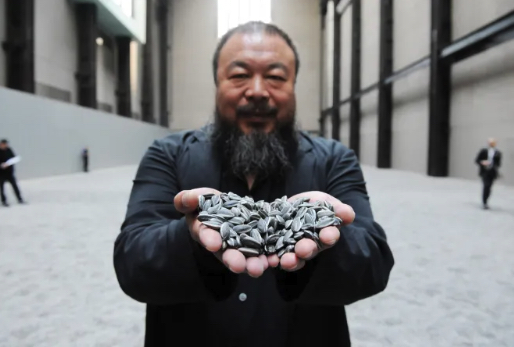
In 2010 he filled Tate Modern with several million porcelain sunflower seeds hand-painted in China. In 2019 in Dusseldorf he packed the gallery with 164 tonnes of rebar steel salvaged from the Sichuan earthquake that killed more than 69,000 people, including thousands of children and students. Ai organised a “citizens’ investigation” to name the child victims in response to the government’s attempt to keep them secret, and to highlight the shoddy standard of school buildings. Last year in Seattle he opened a retrospective across three venues featuring 130 works. But none of those big events is as big as the one heading for Lancashire.
First, though, why doesn’t he recognise me? I’m mildly upset. I was the first foreign journalist to interview him. In 2003 we spent many hours in his fabulous Beijing studio discussing the state of Chinese art and his role in curating a notorious Shanghai exhibition entitled, with spectacular directness, F*** Off. For some reason the authorities didn’t like it. Can’t think why.
To jog his memory I pull out my phone and find some wobbly footage of him cycling to work and the two of us seated in his gleaming white office discussing Chinese creativity. Ah, yes. Now he remembers. “You look young,” he praises a mite grudgingly. Political naysaying on a global scale clearly isn’t great for a man’s hair.
In 2003 Chinese contemporary art was a newcomer to the creative stage. China did not have a pavilion yet at the prestigious Venice Biennale. Few people had heard of Ai Weiwei. No one outside China was ready for F*** Off.
The show’s most notorious artist, Zhu Yu, had filmed himself eating what was alleged to be a human foetus in an investigation of the Christian notion of transubstantiation. An artistic couple, Sun Yuan and Peng Yu, were making art with her period blood and a glass case filled with poison gas. Ai had photographed his hand giving Chairman Mao the finger outside the Forbidden City. Drastic things were happening in Chinese art.
“If you’re under an authoritarian state, the work is dark, moody, expressional,” he explains. “It’s always like that. You see it in German art. But in England it’s different. It’s more like a watercolour type.” He picks David Hockney as an example. Hockney, who died this month, was sweet and kind. “A friend of an undefiled generation.” Ai’s own past was anything but undefiled. The son of a celebrated poet who was sent to the labour camps in China’s far north for being a “rightist”, he spent his childhood in impoverished exile.
To get on his good side, I quote from one of his father’s poems, a lament about being brought up by a wet nurse and not knowing who your mother is. Is that what exile feels like?
“Exile means you constantly feel you’re an outsider. And that provides an interesting condition. Because you’re always curious about something new. You have to adjust to something different. You don’t belong to the land, the customs, the language you know.”
The film I made in 2003 needed to be covert. China was changing, but not so radically that a foreign journalist could breeze in and interview local artists about eating babies. What I encountered was genuinely shocking. An artistic culture seemed to have embraced extreme darkness because extreme darkness was the only viable response. Before the film was even shown, the Conservative politician Ann Widdecombe was standing up in parliament demanding it be banned.
Weirdly, interestingly, Ai was probably the least shocking of the artistic troublemakers I was sent to investigate. His studio on the outskirts of Beijing was huge and totally conspicuous. I’d been expecting a dark estaminet filled with furtive dissidents scuttling about like rats, but here was a gleaming modern complex posher and roomier than most of the white cubes we had in London.
How did you get away with building it, Weiwei? “At that time, every village wanted to rent out their land because they were growing vegetables they could not sell in the market. I said I want to build something. They said they did not care what we build, but it’s not… clearly lawful.” More precisely, it was totally illegal.
From the start his relationship with the Chinese authorities seems to have been more nuanced than we western outsiders can confidently grasp. A couple of years after I met him in his illegal studio, he was asked to design the stadium for the 2008 Beijing Olympic Games. True, he fell out with the authorities about it and tried later to disassociate himself from it, but the gig was accepted and the Bird’s Nest stadium turned out wonderfully.
Every time they lock him up or refuse his visa, he comes back later and appears forgiven. At the end of last year, after a decade in exile, he returned to China with his son, Lao, 17, and posted photos on Instagram of the two of them visiting his 92-year-old mother.
What are your politics, Weiwei? I’m confused by them. “I would say I’m a conservative liberal,” he says eventually. “If you are idealistic, if you’re poetic, that means you’re liberal.” But a conservative liberal has to question his values. He has to act as well as talk. “To bear responsibility. Because every effort will have a consequence.”
He’s 68 now. Has he grown more conservative as he’s grown older? Yes, he has. “I think age always makes people more conservative, because physically you realise you’re not going to be young for ever and our mind adjusts to our physical condition.” Recently he admitted he felt too old for London. “In London you feel a little bit in the way of the young people.” But his son is studying there and loves it, so he has promised not to criticise London any more.
Between 2015 and 2019 he lived in Berlin, but left under a cloud because “Nazism perfectly exists in German life today”. Since 2019 he’s been living in England, most recently in Cambridge. He has also built a beautiful studio in Portugal. It’s all go in the Ai Weiwei household.
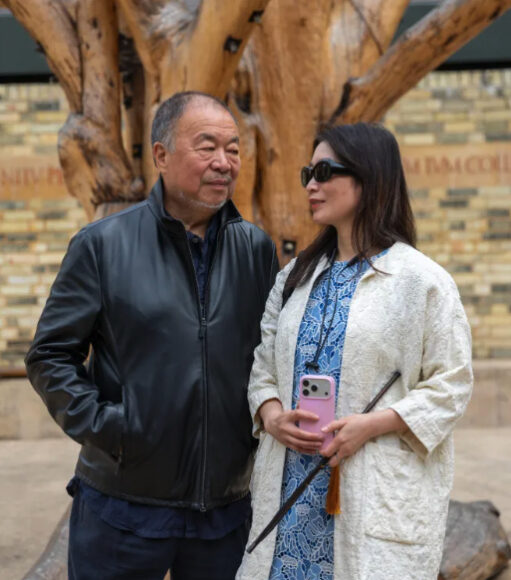
His partner, the film-maker Wang Fen, who’s 48, is with him when we meet in Cambridge, and while she takes pictures of us talking, he takes pictures of her taking pictures of us. Their evident love is sweet to watch. This cuddly Ai Weiwei is not the Ai Weiwei I was expecting. It’s not the Ai Weiwei the world thinks it knows. But it is, I reckon, the real Ai Weiwei.
What about his Manchester show? Apart from featuring most of his best-known art — the creepy models of the prison he was kept in when the Chinese authorities jailed him for 81 days for supposed tax evasion in 2011; the gigantic boat filled with shadowy refugees, through which he lamented the fate of the modern immigrant — the big display is going to feature big new things.
The most ambitious is Eight-Nation Alliance Flags, a protest about the invasion of China in 1900 by the European allies plus Japan and America. Led by Britain, the western world decided China needed to be more open to foreign domination. So an army was sent over to enforce the new freedoms.
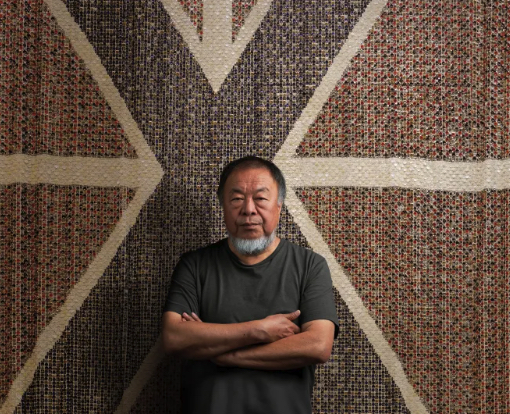
Each of the invading countries has a flag handmade in China from buttons Ai bought from A Brown and Co, a button wholesaler that was closing down in Croydon. “I said, ‘How many do you have?’ They said, ‘A lot.’ I said, ‘Please let me have them.’ So we negotiated.” He thought there might be 50 types of button. There turned out to be 9,000. Millions of buttons that together weighed 30 tonnes.
The British buttons were smuggled into China. Each flag contains about 300,000 of them. And the sewing is being done by some old ladies in Shandong province who have nothing else to occupy them and love the work. “If you retire, it must be great to have some purpose,” he smarms. I ask him if he’s paying them minimum wage. I don’t think he hears me.
Another new work is a gigantic history of bombs made from “toy bricks”, an Ai euphemism for Chinese-style Lego. Having tried to make artworks out of genuine Lego, and having had the request refused because Lego did not want its bricks used for political ends, he works these days with Chinese bricks made by Woma. “Forty colours, same quality, but much cheaper. One tenth of the price.”
History of Bombs will be the largest toy-brick piece ever made. It’s a kind of West v East in which the innocence of the Woma bricks is being compared with the destructiveness of the nuclear device, nicknamed Fat Man, that the Americans dropped on Nagasaki in 1945.
The bricks and the buttons are part of an interplay between capitalism, war and the changing state of nations that forms a poetic daisy chain in his thoughts. Whatever else Ai Weiwei is, he’s not a firebrand or a man who seeks the gallows.
When I met him in 2003 he gave me a plain brown Han dynasty pot, 2,000 years old, which I brought home and treasure for its warmth and earthy calm. I see it now as a kind of self-portrait. He too is warm and earthy, quiet, full of love. There’s something calm and ancient about his wisdoms. That, I feel, is the true Ai Weiwei.
The other one — the extreme dissident, the political firebrand — is a creation of the West. Not the East.
Ai Weiwei: Button Up! is at Aviva Studios, Manchester, Jul 2-Sep 6