Nietzsche, the pessimistic German philosopher, obviously woke up on the right side of bed when he wrote: “When I seek another word for ‘music’, I never find any other word than Venice.” Perhaps he had been listening to Black Sabbath the night before. Or God Hates Us All by Slayer.
Even by the standards of the world’s most chaotic art event, the unfoldings at the Venice Biennale this year have been brutal. When you invite the nations of the world to express themselves in art in a floating city renowned historically for decadence, corruption and prosecco, you are asking for trouble. And the call has certainly been answered.
As I write there are helicopters buzzing above me and chanting crowds protesting noisily outside the show. I’m not sure what they’re protesting about. There’s so much to choose from.
It was the turmoil in the geopolitical cosmos that stuck the fatal dagger into the Biennale’s heart. First, there were events in Gaza and the situation with Israel. Then the Venezuelan pavilion was closed. Then Trump issued new demands for American art in the American pavilion. Then Iran happened. Then the South Africans went mad and banned their own pavilion when their artist started protesting about the treatment of women around the world.
But the biggest turmoil, the loudest noise, the deepest grief, concerned the Russians. Having missed the previous two Biennales after their invasion of Ukraine, they were invited, once again, to show in Venice. Outside of Moscow, no one could believe it. Even Hieronymus Bosch would have had difficulty capturing the ensuing turbulence.
The Biennale was never supposed to be like this. The first one, in 1895, was mounted to celebrate the silver wedding of the Italian king Umberto I and Queen Margherita di Savoia. Its ambition was to bring artistic happiness to all. But you know what weddings are like. There were arguments over the guest list. And here we are, 130 years later, still arguing over who should or should not be allowed into Venice.
In 2022 Russia’s artists withdrew from the biannual fracas, unable to face the guilt of Ukraine. Two years later they handed over the pavilion to their “friends in Latin America”, the Bolivians, who used it to propose a philosophy of time that involved “moving into the future while looking at the past”. It was, I think, some sort of twisty post-Soviet code for allowing Putin to restore the old borders of the Russian imperium.
No one expected the Russians to return this time. Yet out of the blue came the news that they were back and their show was to be entitled The Tree Is Rooted in the Sky, a line inspired by Pushkin about a “tree of life” whose roots “reached down into the depths of the earth and whose branches reached up to the sky”. I wonder if Russia’s soldiers have been reciting it to the mothers of the Ukrainian children they’ve been blowing up in Donetsk?
The Moscow tree show, we were told, would feature an international cast of 50 musicians, poets and philosophers. Its aim was to celebrate how “eternity prevails over momentary concerns”. The opening day of the Biennale, May 9, was also the day of Moscow’s annual victory parade. What a surprise.
Russia’s recall was defended by the president of the board that runs the Biennale, Pietrangelo Buttafuoco, a former ally of Italy’s leader, Giorgia Meloni. Buttafuoco explained the unexpected welcome with some guff about the Biennale being “a place for dialogue”. Cue international guffaws.
The Italian press has been savage in its condemnation of the decision. Meloni’s cultural minister was so upset he refused to attend the Biennale opening. The EU said it will withdraw its €2 million funding from the event.
The qualms intensified when we learnt that the Russian pavilion’s operator, contracted until 2029, is Smart Art, a company founded by Anastasia Karneeva, the daughter of a former FSB general, and Ekaterina Vinokurova, the daughter of Sergey Lavrov, Russia’s foreign minister.
But whatever it was that persuaded Buttafuoco to welcome Putin also gave him the strength to ride out the flood of ensuing protests. And on the opening day of the previews Russia’s sulky green pavilion with its deceptively folky silhouette was pumping out rave music so loud it was shaking the surrounding vegetation.
Anxious to find out why trees are rooted in the sky, your intrepid reporter braved the noise and went in. I didn’t feel good about it, but it seemed important to see what was actually going on.
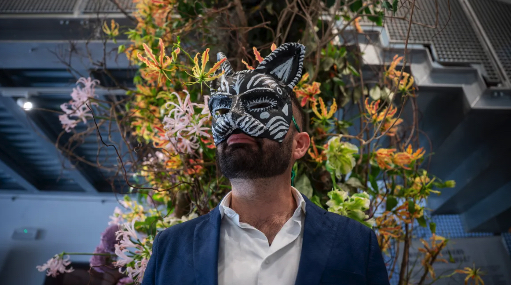
At the door a man in a spangled fox mask waved me into a room filled with huge vases of flowers. Roses, lilies, peonies everywhere. Behind him, a large white box was filled with what looked like lightly used designer clothing. An attached sign encouraged you to take what you wanted — free of charge.
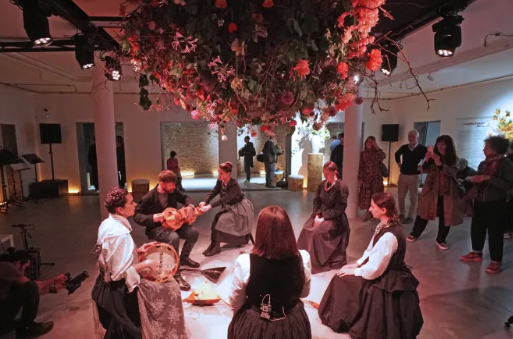
The enormous display of botany turned out to be part of a lament by Timofey Dudarenko about how flowers don’t smell any more because they have been factory-grown and mass-produced. The Earth deserves better, was the message. So I sniffed and sniffed but no amount of vigorous smelling could elicit a scent from the Russian flora. Timofey, I fear, is right.
In the pavilion’s main space, a pair of nodding Brazilian DJs were blasting out horrendously loud dance music. And a few prowling Russians in groovy streetwear were encouraging us to dance. No one dared. It was like one of those sad parties where everyone stays in the kitchen.
Upstairs, an open bar was keeping up a nonstop supply of free vodka and prosecco. The entire pavilion seemed determined to convey the message: dance, drink, smell the flowers. Or, as Russia’s Biennale spokesman, Mikhail Shvydkoy, put it, “culture prevails over politics”.
Settling down on one of the straw seats scattered round the free bar, I accepted a gin and tonic and was enjoying it guiltily when a sinister-looking Russian spiv sat down opposite me and appeared to be taking my picture on his mobile phone. That’s when I scarpered.
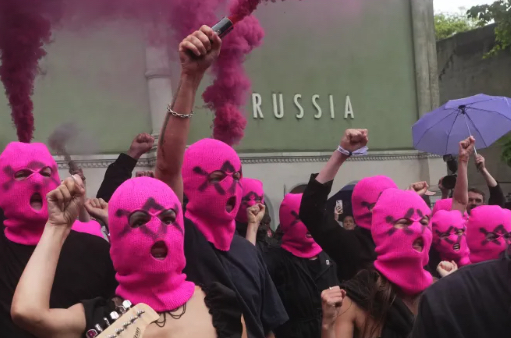
That afternoon a noisy protesting mob arrived outside the pavilion led by Pussy Riot, the Russian punk anarchists who have bravely opposed Putin. Dressed in black nighties and pink balaclavas, they let off pink flares and blocked the road with screams of “No Putin in Venice”. They told us to beware of soft Russian power and piled on my guilt for the G and T. “Art for show, graves below”, read their placards.
Next up was a team of Polish curators with another set of protesting flags. Then everyone’s attention turned to the Origami Deer, a sculpture made of concrete that had been saved from destruction in eastern Ukraine and driven across Europe by lorry all the way to Venice, where it was now parked, outside the Spanish pavilion, looking across at the Russians.
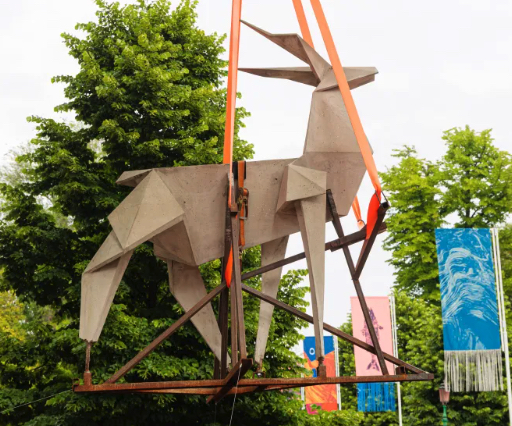
Before it was removed from the path of Ukraine’s invaders, the Origami Deer could be found in a park in Pokrovsk on the site of a dismantled Soviet nuclear jet. Attached to the side of the lorry that carried it to safety was a curt text reminding us of the security guarantees Ukraine had been given when it gave up its nuclear arsenal.
Confronted by the tide of opposition, Buttafuoco and the Biennale board finally blinked and announced that the public wouldn’t be able to enter the Russian pavilion, and would just see video projections of its interior, while the rave music played on.
Thus the tree rooted in the sky turned out to be a willow — drooping, sagging, weeping.
The best of the Biennale
Georg Baselitz: Eroi d’Oro
Cini Foundation
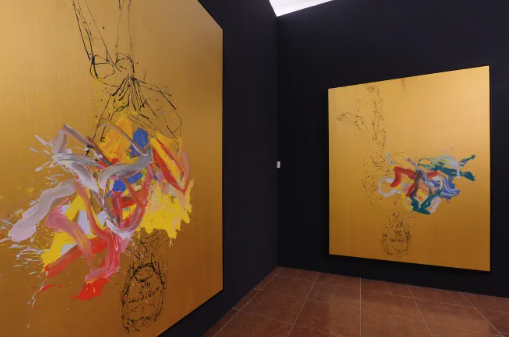
Baselitz’s golden show is a magnificent farewell from one of the greatest painters of recent times. His death aged 88 last month gave this event a memorial tenor. He knew his end was coming. This was his way of saying goodbye.
There’s a touching video shot two weeks before his death, in which the frail but determined Baselitz talks us through what he hoped to achieve in this fabulous farewell.
Dana Awartani
Saudi Arabian Pavilion, Arsenale
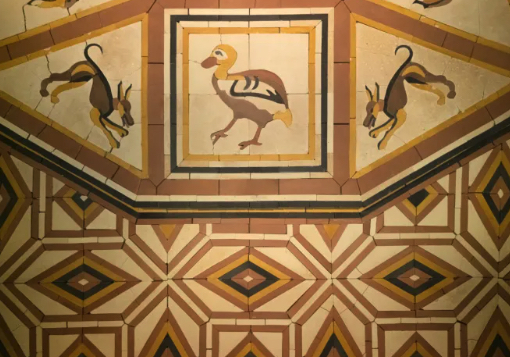
The arrival of Arab pavilions at the Venice Biennale has generally told us more about money and power than it has about art. This show is a change of heart. Entitled May your tears never dry, you who weep over stones, it’s a lament for events in the Middle East that never mentions wars or conflict or oil, but feels like a response to all of them.
In the Saudi Arabian pavilion, Dana Awartani’s haunting contribution, right, consists of scores of geometric mosaics arranged on the floor in a super-mosaic. Each piece is made of coloured mud baked by the sun. All are based on the floors in important buildings of the Middle East.
What unites them, what fills this sight with sadness, is that all the buildings have been damaged or destroyed in recent conflicts.
Lorna Simpson: Third Person
Pinault Collection
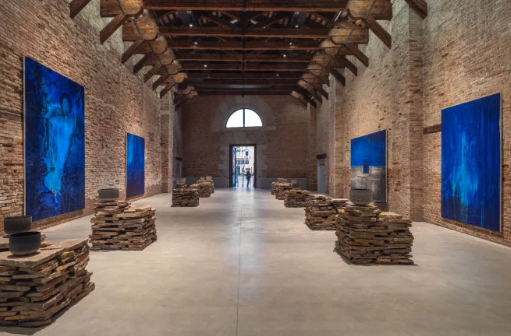
This tasty Lorna Simpson retrospective, above middle, is fabulous from beginning to end. In a clever touch it starts with bold new work then goes backwards to her 1980s beginnings. We go from sculptural vases that seem to scream with pain when you run your finger round them to drifty evocations of the Arctic Sea that seem to echo the watery moods of Venice.
Gabrielle Goliath: Elegy
Chiesa di Sant’Antonin
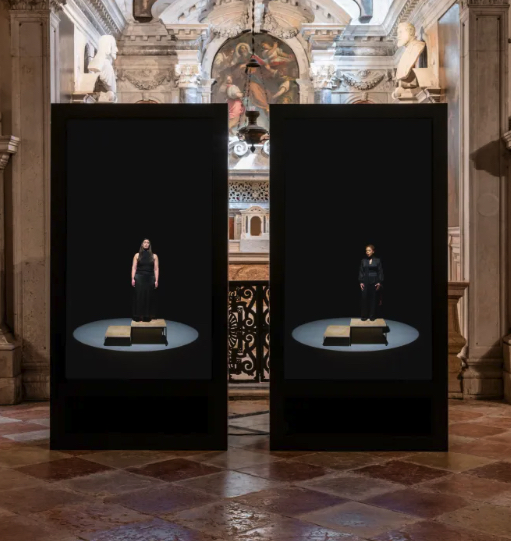
This show was meant to be South Africa’s official contribution to the Biennale, but the sudden decision to ban it resulted in it having to be moved to the beautiful church of Sant’Antonin in Castello. Frankly, it’s a much better location.
What we have here is a lament for the treatment of women prompted by episodes of rape and ignoral in South Africa. Not that it’s obvious. A suite of lifesize video screens feature a procession of singing women who step into view and hold the same note till their breath runs out and the next woman takes over: a daisy chain of vocal resistance.
Big Chief Demond Melancon
Giardini and Arsenale
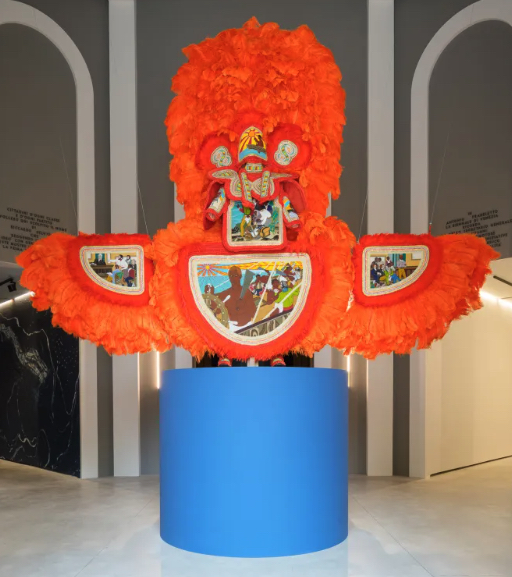
You cannot miss Big Chief Demond Melancon’s contribution to the 61st Biennale. It blocks the entrance to the main show.
The theme of the entire Biennale is supposed to be In Minor Keys and the idea is to foreground gentler, less macho contributions. But there’s nothing minor key about the scarlet carnival costume that Big Chief Melancon has made. With its huge ring of ostrich feathers and beads, it’s a noisy masterpiece of extravagance.