Let’s get the formalities over with immediately. Zurbarán at the National Gallery is one of the greatest shows I have seen. Do whatever it takes to witness it. Take a hammer to Granny’s piggy bank if you must. It’s worth it.
You’ll want to know why. Here we plunge into complexities. Some are religious. Some are aesthetic. A few, perhaps the most precious, are — roll the drums — spiritual. A tremendous artist is talking to the inchoate stuff deep inside. He’s talking in Spanish, yes, which can translate awkwardly, but your soul speaks Esperanto, so don’t worry. You’ll get it.
Francisco de Zurbarán (1598-1664) was a product of Spain’s golden age, the fabulous 17th century that also gave us Velázquez, Murillo, Juan Martínez Montañés, Pedro de Mena and, if you’re being generous in your definitions, El Greco. Spanish art was never as relentlessly impressive as it was in this powerful epoch.
Most modern observers would pick Velázquez as the best proof of that, but I suggest Zurbarán has a stronger case. He could do most of the things Velázquez could do — he could certainly do startling realism — but with Zurbarán the facts are turbocharged by a darkness that makes his work feel prickly. Zurbarán trumps Velázquez in his strangeness.
The National Gallery show proves this with its first painting, an extraordinary scene of St Peter Nolasco imagining the crucified St Peter. I’ve named the protagonists, but you do not need to know who they are to enjoy the picture. You just have to look.
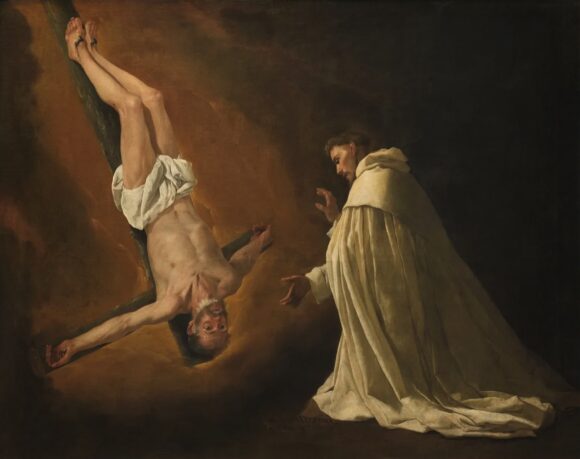
A spectral chap in ghostly white robes is kneeling before an almost naked man who is upside down and crucified. They’re surrounded by blackness. We have no idea where they are.
If you turn the upside-down figure the right way round, you’ll see that his expression is actually rather serene. But in the painting, inverted, the grimace feels devilish. The artistic mind that came up with this crazy religious scene was inventive, fierce, cocky and maybe, just maybe, hallucinating on Mexican peyote. Zurbarán in a nutshell.
Also in the opening room is an early crucifixion, strikingly spare — just Jesus, the cross and darkness. It shows off the “sculptural quality” of Zurbarán’s vision, the dramatic use he makes of shadows to push Jesus’s sweaty body at us from a dark niche.
Completing the room is another white-robed saint called St Serapion, about whom I know nothing, and don’t need to. What counts here is how weirdly he’s stretched between two ropes and the spectacular detail with which his white Mercedarian robes have been recorded.
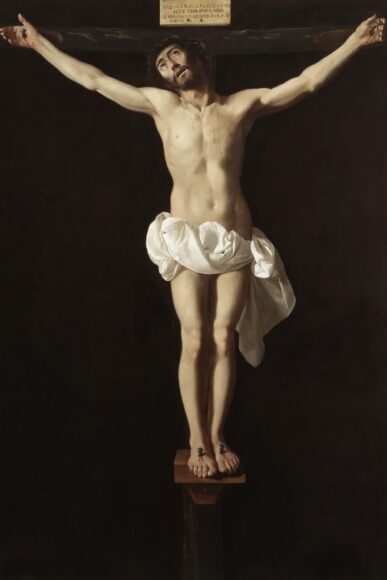
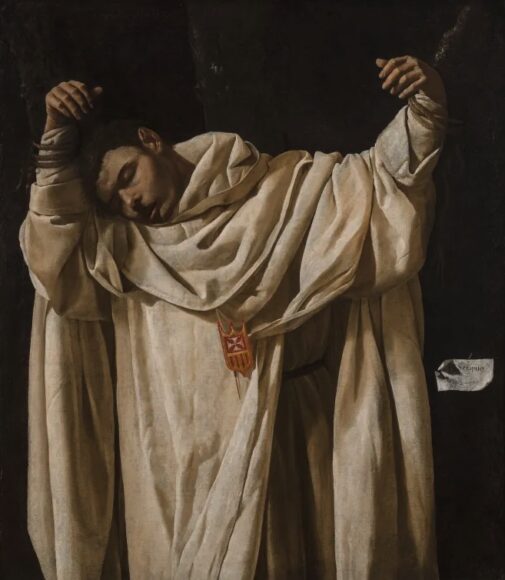
I spent 15 minutes in front of St Serapion enjoying those snowy robes. Then I went back to Jesus’s skinny loincloth and enjoyed that. Not even Velázquez was as skilled at capturing fabrics as Zurbarán. He was surely the most exciting painter of cloth there has ever been.
Why was he so good at it? I happen to know the answer because I once went on a pilgrimage to his home town of Fuente de Cantos in Extremadura. When I say town, I’m being generous. It’s marginally more than a village — whitewashed, sunbaked, lonely — the kind of place Clint Eastwood rides into in spaghetti westerns.
The house where Zurbarán was born is the town’s only tourist sight. His father was a cloth merchant who sold fancy silks to the rich people of Seville. According to the town historian, Zurbarán was advertising his dad’s wares in his paintings. Not so much in the dead Jesuses and St Peters — although their loincloths are spectacularly white and crisp — but in the row of female martyrs who come next.
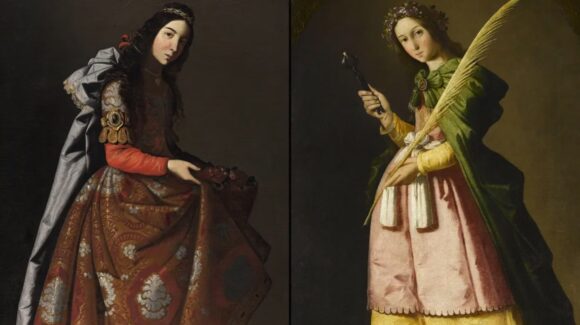
Zurbarán’s female saints sport such a gorgeous array of outfits they turn the gallery into a catwalk. St Apollonia, who had all her teeth pulled out, is in gentle pink and sunshine yellow. St Casilda, the Muslim princess who brought bread to Christian prisoners, is in exquisite damasks of brown and silver. All through the show you are forced to notice how deeply Zurbarán imbibed his father’s intimate knowledge of fabrics.
The ornate martyrs are joined by gripping images of St Francis where, once again, the cloth painting does much of the heavy lifting. For Zurbarán, every scrap of fabric was an opportunity. This time it’s the coarse and scratchy monkish robes that make you gasp at their exactitude.
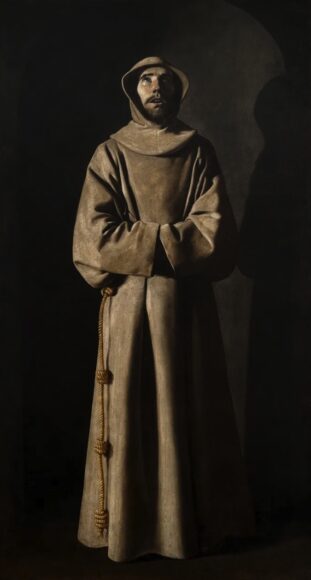
In the spookiest of the St Francises, he paints another fabulous Catholic vision where Pope Nicholas V claimed he saw the saint’s body in the crypt in Assisi, untouched by death. No one has ever painted Catholic impossibilities as trustingly and inventively as Zurbarán. His undead St Francis, spotlit in the dark, staring up to Heaven, is such a haunting image.
There’s so much to admire on this journey. Zurbarán’s still lifes — some simple pots, a plate, a jug on a shelf — ooze an unsettling austerity and seem to be wagging a finger at all those baroque banquet tables overloaded with fruits and foods. The still life as reprimand.
Out of the blue, the curators confront us with a colossal painted head, 8ft by 7ft, which they propose is a forgotten Zurbarán. The weirdness of this remarkable giant feels right, but with nothing else in art remotely like it, any assessment is speculative.
It’s a rare doubt in a parade of masterpieces. Some might be tempted to view Zurbarán’s intense Spanish Catholicism as a barrier, but it’s just a doorway to extraordinary imaginings. The captions are really helpful. Savour every moment.
Zurbarán is at the National Gallery, London, until August 23