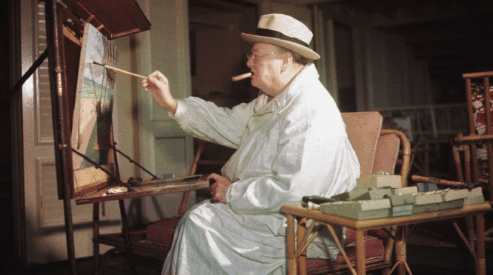
As I marched through the selection of paintings by Winston Churchill that has trooped into the Wallace Collection some bad men popped into my thoughts. Very bad men.
The Wallace has brought together a hefty selection of the 500 or so oil paintings Churchill produced in his artistic career. The hope, I suppose, is to position him as some sort of British approximation of a Renaissance man. Not only was he the war leader who fought them on the beaches, he also won the 1953 Nobel prize for literature for his copious histories, and was a trained bricklayer to boot, as we find out in the caption attached to one of his views of his kitchen garden at Chartwell. Astonishingly he made the long wall we see ringing the flowerbeds and would aim to lay 200 bricks a day.
But we need to get back to the bad men. First there was Hitler, who, of course, also fancied himself as an artist. Indeed, art was going to be his first career. He applied to the prestigious Academy of Fine Arts in Vienna, twice, but was rejected. So he switched his ambitions to world domination.
Then there was Francisco Franco. The fascist dictator of Spain dabbled vigorously in art and was more than proficient. His speciality was animals shot in the hunt. Franco was an even better draughtsman than Hitler, which is saying something, given how precise Hitler was in his views of picturesque German castles. Your gut tells you to dismiss his art as feeble, but your eyes disagree.
Mussolini, I don’t know about. He was certainly an art lover. His government put huge amounts of energy and resources into controlling Italy’s cultural output. It was the support of the Fascisti that made the Venice Biennale the huge event it is today. But I cannot confirm if Il Duce also picked up the brush. Perhaps he was that rare thing — a fascist dictator who didn’t paint.
All this adds up to more than a coincidence. It’s a tendency. Why do egocentric political leaders who have played a meaty role in history fancy themselves also as artists? After all, it doesn’t work the other way. You never hear about artists wanting to become dictators. Picasso had big political views — he supported the Communist Party fiercely — but he never expressed a desire to run Spain.
Things grow even muddier if we broaden the political ring. Among American presidents it’s not just Trump and the little nude he may or may not have added to Jeffrey Epstein’s birthday book that attest to a Jeffersonian interest in picture-making. Eisenhower painted. Carter painted. Clinton draws. George W Bush has devoted himself so furiously to painting since he invaded Iraq that these days it’s what he’s known for. Who can forget his spooky portrait of Vladimir Putin?
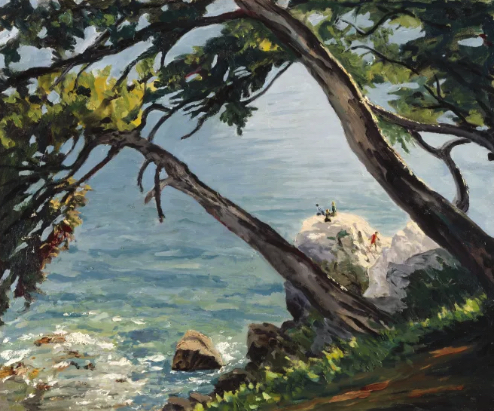
Why do statesmen want to become artists? The question kept returning like a bout of hiccups as I strolled from location to location in Churchill’s great escape into art. From Cap d’Antibes to Marrakesh, from Venice to Lake Maggiore, from Blenheim Palace to the Château de Saint-Georges Motel, Churchill and his portable easel certainly got around. He visited friends in their castles, lunched before pleasant views and took recurring pleasure in water. But what sort of a journey was this really?
According to the show’s wall texts, Churchill’s artistic voyaging was triggered by failure. In 1915, while first lord of the admiralty, he had instigated the landing at Gallipoli, a disastrous campaign that led to a quarter of a million Allied casualties. Blamed for the loss, he fell into a great depression, that notorious black dog of his, and turned to art as solace. Clementine, his loyal and long-suffering wife, traced all his artistic interest to Gallipoli.
He was 40 when he took up painting. The show has no juvenilia, no teenage sketches. One minute Churchill is a failed quadragenarian first lord of the admiralty, the next he’s a painter of moody studio interiors and melodramatic self-portraits, working under the tuition of the established and excellent John Lavery.
Is there a missing stash of early work? Was he, like Queen Victoria or more recently King Charles III, a product of a social class for whom learning to draw had been an important part of his upbringing? The show doesn’t say. What is certain is that his posh roots and high political standing made it easier for him to gather quality mentors. Lavery was followed by William Nicholson who was followed by Walter Sickert. It’s an impressive cast of teachers.
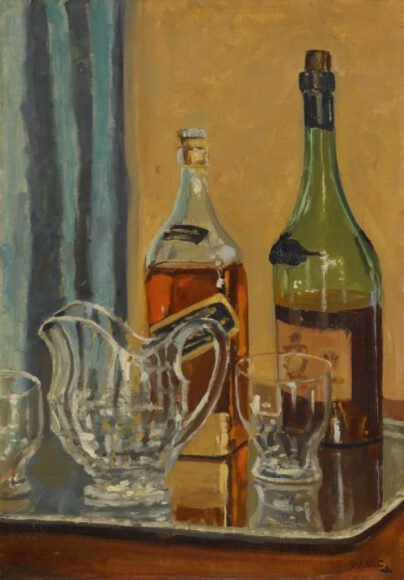
From Lavery he learnt how to paint dark interiors where the light struggles in — a useful talent if you’re visiting posh country houses in Britain. From Nicholson he learnt how to paint flowers and loaded still-lifes. The show’s best image, a row of bottles centred on a giant bottle of brandy, is both evidence of Churchill’s alcoholism and a reminder of Nicholson’s sophisticated influence.
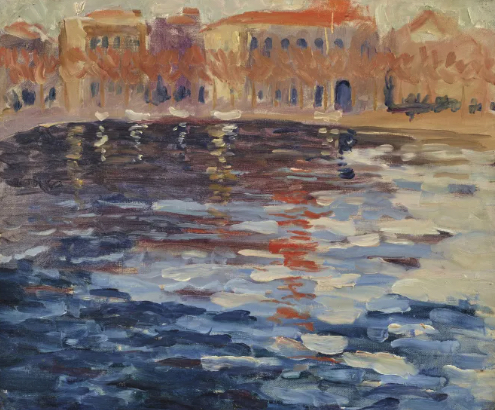
Yet it was Sickert who had the greatest impact. Two thirds of this lengthy recap consists of a belated post-impressionism that would have had Hitler reaching for his Luger: sunny views of postcard places, recorded with broad and vague brushstrokes, relentlessly bright and based on photographs. Hilariously, Churchill would send his valet to photograph the scene, then work it up at home from the snaps. That’s not Lavery’s example, or Nicholson’s. That was Sickert, whose own career had descended weirdly into the wholesale reworking of photos.
What, though, have we really discovered in this determined attempt to attach great artistic accomplishments to a booming name? Well, we can now see that Hitler was a better artist than Churchill. So too was Franco. We’ve learnt as well that having your valet take photographs of pretty spots for you to copy back in the studio leads to brightly coloured postcards, not to sensitive landscapes.
More profoundly we have proof here that art is not only a great escape but also a great leveller. Kids do it, dictators do it, national heroes do it. I remember David Hockney pointing out the same thing when I visited him between lockdowns during the Covid crisis. The whole world appeared to be rediscovering the joy of art. Reese Witherspoon was at it. Sylvester Stallone was at it. Brad Pitt took up sculpture and pottery. Anthony Hopkins was producing self-portraits.
The podcast I do, Waldy and Bendy’s Adventures in Art, had been flooded with messages from listeners writing to say how much their children were now loving drawing. They’d forgotten what fun it was. Covid had reawakened a passion that had been buried. “You can’t tell a three-year-old not to draw,” Hockney drawled in his lovely Yorkshire way. We’re hardwired to make art.
It’s something that needs to be told to the noddies who run our education system and who are busy closing art classes in favour of economics courses. If art was good enough and important enough for Churchill, it’s good enough and important enough for everyone.
Winston Churchill: The Painter is at the Wallace Collection, London, to Nov 29