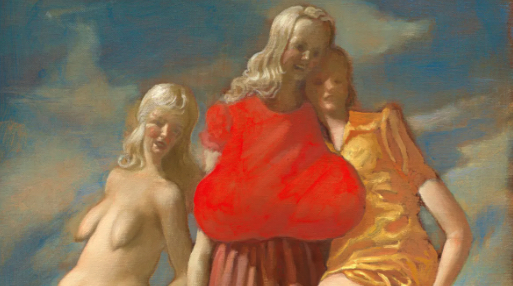
Good or bad? That’s the question that buzzes round my head like a wasp at a barbecue whenever I encounter the work of John Currin. You swat it away, you bash it with a fork, but still it keeps returning. Is this good art or bad?
To an obvious extent, the answer depends on your sex. I asked something similar on my Instagram account (@artywaldy) and the responses divided neatly along gender lines. Most women hated the pictures, accusing Currin of extreme misogyny, with a few demanding he be cancelled. Most men thought otherwise. “Quelle surprise,” I hear half of you mumbling.
Drilling down into the responses, what was noticeable was that women generally assumed Currin was being insulting about women’s bodies. But the men did not. It’s as if the female view of a female body is more idealised. Women imagine other women to possess proportions like the Venus de Milo. Men, however, respond happily to all shapes and hangs: big, small, pert, droopy. I’m freewheeling, but something of that sort is definitely happening with Currin’s art.
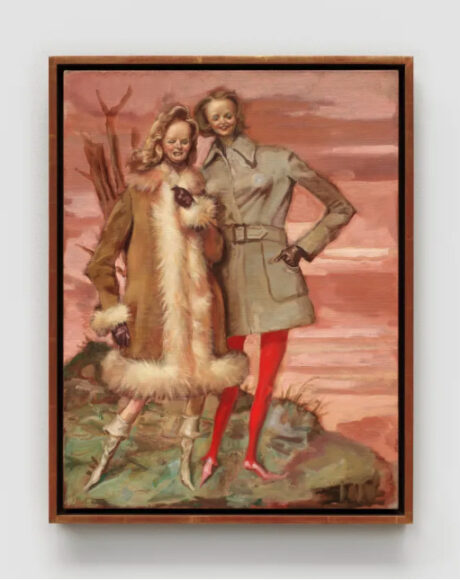
You can judge for yourselves at the Sadie Coles HQ, a gallery run by a prominent female dealer who has been championing his work for 30 years. The uncertainties obviously appeal to her more than the certainties because it’s hard to imagine how Currin, a self-styled “ham-fisted American”, born in Colorado in 1962, could have appeared less in step with contemporary mores than he does at this cornucopia of gender malfunctions.
Although he can’t actually confront Laura Mulvey, the inventor of the concept of “the male gaze” in her seminal 1975 essay Visual Pleasure and Narrative Cinema, and shout “Take that, Laura”, given the opportunity he would, you feel, grab it.
The show consists of a dozen paintings and a portfolio of matching drawings, all of which feature a female twosome or threesome: clothed, unclothed or a bit of both. Judging by the fashions they are wearing, or nearly wearing, and the hairstyles they favour, they are not from the here and now but from America in the Seventies, where Currin was a teenager.
All the women are conspicuously “breasty”, sporting prominent boobs, large and small. All are painted in a pseudo old master manner, as if that louche French pleasure-peddler of the 18th century François Boucher has been resurrected and transported to the social circles described in that marvellous film The Graduate, where he can now turn his rococo eye on the Mrs Robinsons: American women of a certain age.
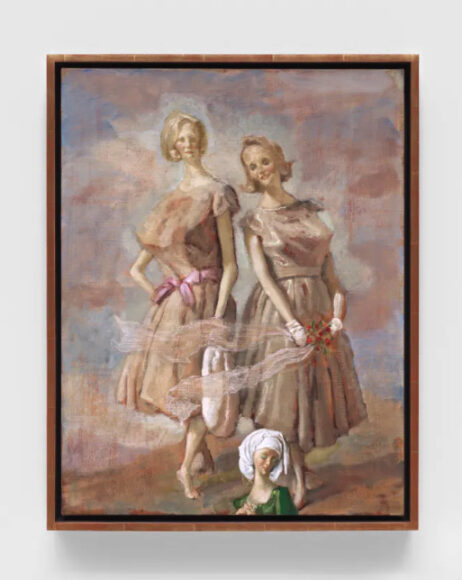
The landscape the women wander through feels imaginary too, and also has something of the rococo era about it, with pretend trees and fluffy clouds by the yard. It’s as if a boatload of historic American Milfs has arrived on an Island of Love painted on to the walls of Marie Antoinette’s bedroom in the Petit Trianon, and split up into small groups to explore.
So far, so dodgy. But being struck here as well is an immediate note of humour, with a side note of satire. The cornucopia of boobs may be the first thing you notice but soon after you begin sensing that the fashions being worn and unworn here are also significant. However raggedly one of Currin’s Mrs Robinsons has been dressed by Mad Max’s tailor, her shoes will always remain impeccably polished and pointy.
There’s definitely some social joshing. And the women are certainly being ribbed by a witness to their Seventies vanities. But that doesn’t explain the brazenness with which they unveil their genitals, nor does it account for the boobs that are repeatedly exposed, especially the gigantic ones that look as if they have been borrowed from the celebrated prehistoric carving the Venus of Willendorf, art’s first fertility goddess. The boob worship, you sense, is about something deeper. 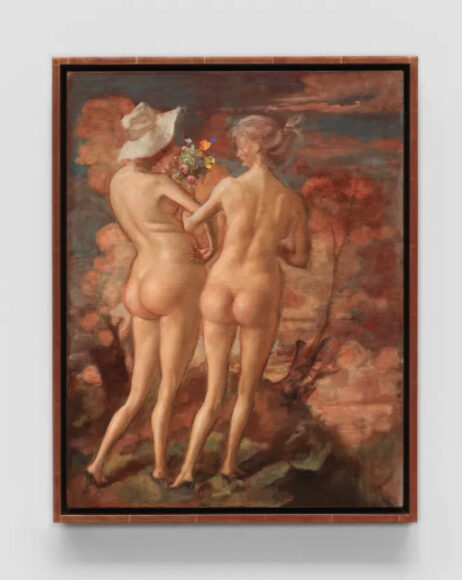
According to the artist, we should understand these paintings as memories. What he is remembering is the women in his mum’s social circle when he was a kid and the fantasies about them that would spring into his excitable pubescent mind. It’s art about the male gaze, but from an artist seeking jokily to show how the male gaze works.
In an interview with Bella Freud that’s on YouTube Currin talks about the “uncontrollable eye” and traces the origins of the giant breasts to a Dennis Potter play called Cream in My Coffee that he saw in the Eighties, in which Peggy Ashcroft starred as a sour and authoritarian matriarch in a black dress with huge boobs. The idea that Potter inspired Currin is so spectacularly surprising I’m tempted to believe it.
What’s certain is that this edgy, provocative, divisive, unsettling artistic vision is taking us somewhere we’re not used to going. The softcore European artistry that Currin is quoting, the daft rococo dreams of Boucher and Fragonard, is having the mickey taken out of it by an American blockhead whose parents came from Oklahoma, America’s least sophisticated state. An Okie from Muskogee has got his hands on a fine stretch of European culture and is peeing all over it.
But — and I think this is important to note and celebrate — there’s a tenderness to be felt here as well. Yes, there’s mockery, but it’s being done gently and with a sense of teenage gratitude grafted to it. “Thank you, Mrs Robinson, for all that you gave us,” whispers this inventive and deceptive event.
John Currin: Opening Credits, is at Sadie Coles HQ, London, to Sep 12
A far from fitting tribute
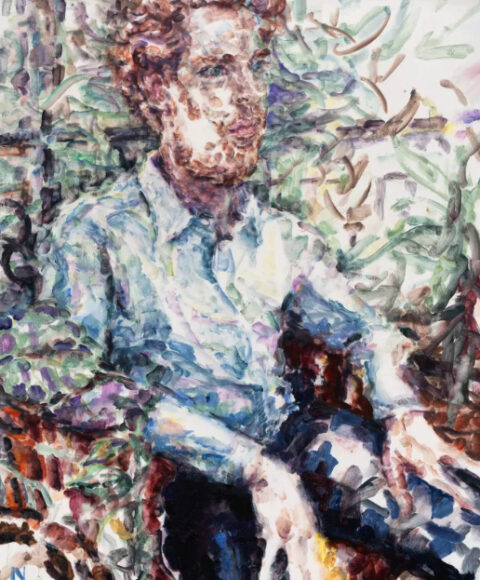
At the National Portrait Gallery the former director there, Nicholas Cullinan now the boss at the British Museum, has been treated to a commemorative portrait painted by Elizabeth Peyton. It’s a tribute worth mounting as Cullinan is our finest museum director and deserves all the plaudits.
But he also deserves a better effort than Peyton’s feeble half-length. Best known for her portrayals of pop stars and Hollywood heart-throbs, Peyton is seriously out of her depth when it comes to less-standardised faces.
You would have thought that the NPG of all places would recognise the need for its portraits to look like the people they are meant to represent, but in this instance that necessity has been abandoned. Instead we get a pale and patchy Ken who should be standing next to Barbie on a toy shop shelf, not filling in for Britain’s best director at his former manor.