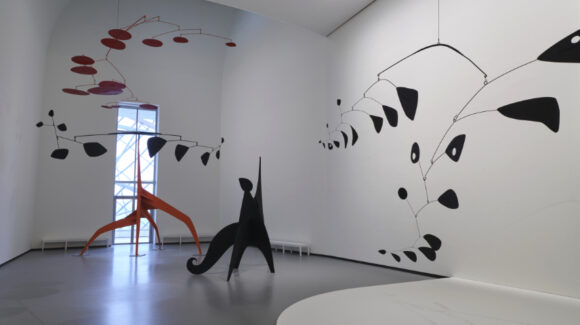
A hunger for innocence.” The phrase pushed its way into my thoughts at the start of the enormous Alexander Calder look-back at the Louis Vuitton Foundation in Paris, and refused to shift through the many rooms that followed.
Calder (1898-1976) is cemented in art history as the inventor of mobiles: hanging sculptures that move with the wind. It’s an artistic achievement so specific it feels at odds with the mobile itself as it flutters and trembles and shifts. Of course, there was more to him than that and this huge Vuitton event has ambitions to be the final word on his true achievements.
Before you enter I recommend a preparatory dawdle outside to admire the wobbly brilliance of Frank Gehry’s Vuitton building as it tilts and screws its way to the heavens. It’s made of concrete and glass, but feels light as paper, as if it were knocked up that morning by a Japanese master of origami.
I dwell on it because the union of Gehry and Calder, the inventor of weightless architecture and the maker of mobiles that shiver in the wind, is perfect. No artist will ever sit as happily in Gehry’s Parisian masterpiece as Calder sits there now.
What, though, of the hunger for innocence? When Calder was 11 he gave his parents a Christmas present he had made, a pair of animal sculptures, a dog and a duck, fashioned from thin sheets of brass. His father was a sculptor in Philadelphia, his mother a painter. From the off he had space in their studio. And with a skill no normal 11-year-old possesses he fashioned the metal dog with a curly tail and the rocking duck. Already a wizard with pliers.
The events ahead follow many threads but never deviate fully from what the prepubescent Calder displayed: a sense of fun, a love of nature, a hunger for movement, a skill with pliers. The Calder we encounter at the beginning is basically the one we see 65 years later.
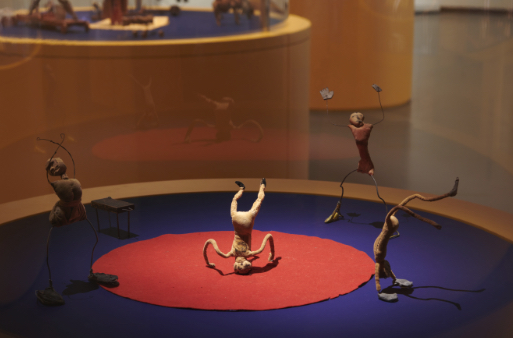
His journey never grows anxious. At art school he tried painting, and in New York night scenes filled with sparkling lights he sought out the insubstantial and the transient. In 1926 he arrived in Paris — the show celebrates the 100th anniversary of his arrival — and began creating a home-made circus, which gets a gallery to itself featuring dozens of pint-sized acts.
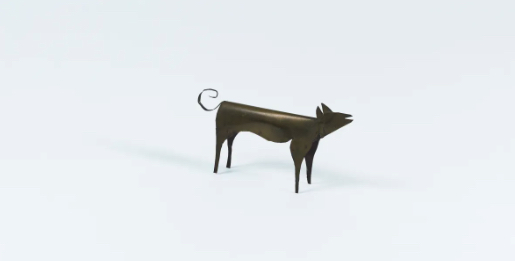
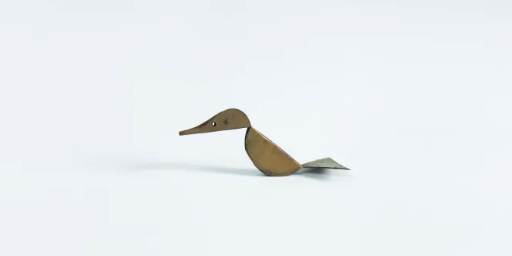
Calder would play with the lion tamers and tightrope walkers, fashioned again with those handy pliers, while his wife, Louisa, was in charge of the gramophone. A fun film, made many years later with the now battered circus props, shows us how fully he involved himself in his big top. Many modern artists of the 1920s were drawn to the circus for its angsty symbolism. Calder, you feel, was happy just to love it.
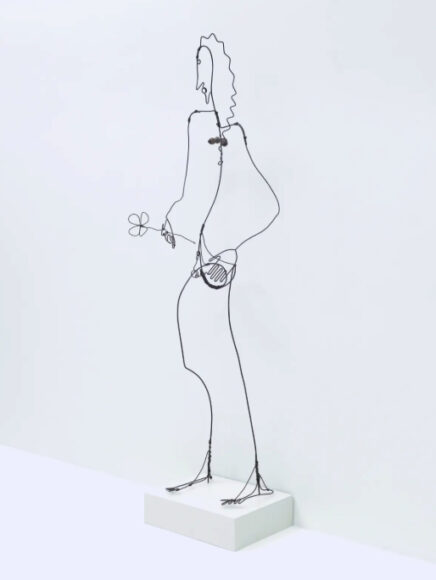
In Paris his skill with pliers earned him the marvellous nickname of the King of Wire. And there really is something magical, a hey-presto mood, about the portraits he made of his Parisian pals with wire threads twisted into convincing 3D likenesses. In a full-length figure of a female nude, representing Spring, he “draws in space” with the wire, fashioning protruding hands, flowers, breasts. To suggest her pubic hair, he adds his own scrawly wire signature, “Calder”, between her thighs.
So far, so simple. He loved innocence, acrobatics, tightropes, cheekiness and animals, and was, I estimate, 80 per cent complete as an artist. The missing piece of the jigsaw was supplied by a visit to the studio of Piet Mondrian in Paris, where he encountered abstraction.
The first suite of abstract paintings he attempted — produced in a mad spurt of 20 days in 1930 — are so telling. Where Mondrian made his squares and grids feel profound, Calder makes them cheeky. Little circles pop up next to big circles, floaty lines appear from nowhere, triangles bounce, colours surprise. Where Mondrian records the geometry of existence, Calder gives us all the fun of the fair, without any of the details.
At about this time he invented the mobile. Sensing that abstraction with brushes was not for him, he returned to sculpture and began “painting in space” with sheets of cut-out metals balanced on wire tripods and thin tightropes of steel. In his earliest efforts the cheeky balances are fixed to the ground: modernist windmills waiting for a breeze. Soon enough, though, they take to the air and feel tangibly happier hanging from the roof — like the trapeze artists and tightrope walkers he adores.
We’re a quarter of the way through the show, but to all intents and purposes Calder is complete. Like his close friend the surrealist painter Joan Miró, he’s conveying with coloured blobs what circus acts convey with acrobatics and balances. Where Miró contents himself with two dimensions, Calder has expanded his art into a third.
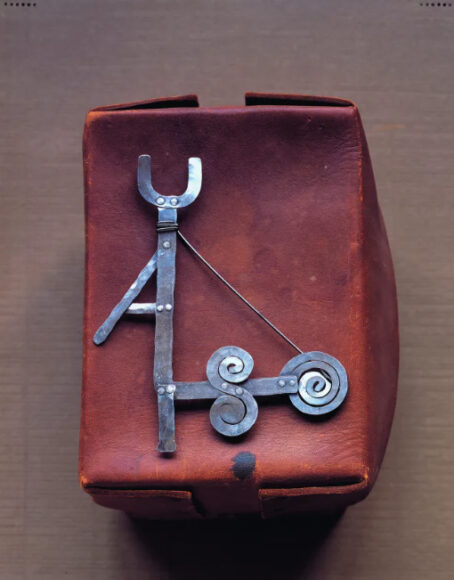
The event tries hard to impose a sense of variety on the 40 years of happy repetition that follow. A section devoted to the jewellery he fashioned for the birthdays of his beloved Louisa shows him swapping sheets of tin for leaves of gold and silver, creating spectacular costume necklaces and super-sized brooches of the type Elizabeth Taylor might have worn as Cleopatra.
A second room is devoted to the striking portraits of Calder taken by his photographer friends: Man Ray, André Kertész, Henri Cartier-Bresson. The moustachioed cowboy who arrived in Paris in 1926 turns into a weighty transatlantic grey hair in the Hemingway mould, knocking out huge public commissions for the world’s squares in the 1970s.
Gently, but unstoppably, his shapes grow more organic. In the years of the Second World War, when sheets of metal were hard to source, Calder hung his mobiles with blobs of wood and found objects. At his most obvious, and least pleasing, he makes hanging fish in which his decorative ambitions are exposed too bluntly.
It’s a revelation that cannot be unnoticed. His abstraction is reality in disguise. The mobiles that hang are like leaves on a branch. The ones that stand are like giraffes in a zoo or that first dog. There’s always something in the room that feels fresh, but also lots that’s interchangeable.
Only in the show’s final step, where his huge public sculptures begin to carve hefty chunks out of the air around them, does he achieve a genuine change of mood. Finally, the art begins to feel profound.
Alexander Calder, at the Fondation Louis Vuitton, Paris until August 16