If you can judge a nation by the artists it has produced — and you surely can — where does that leave us with William Blake? A generous assessment of his mental condition is that he was very odd. A less generous reading, one with which I concur, is that he was certifiably mad, totally bonkers, several gospels short of a Bible.
The first “vision” he remembers came at the age of four, when God poked his head through the window to check on the sleeping infant. When he was eight he saw a tree in Peckham Rye, London, “filled with angels, bright angelic wings bespangling every bough like stars”. Later, there were nightly visits from a dark spectre and faraway trips to the land of the dead. In 1819, in a séance, he saw and communicated with the ghost of a flea. It inspired one of his weirdest paintings.
As I said, totally bonkers. In any other field but art (except perhaps religion itself) the mad fantasies would have led to universal suspicion and incarceration. In the field of art it led to an extraordinary career, to edgy imagery unlike any seen before and imaginative leaps that make you want to cross your toes. In short, it led to uniqueness.
Or so I have happily assumed. Until I visited William Blake: The Age of Romantic Fantasy, at the National Gallery of Ireland. In all my years of Blake-watching I have always understood him as a one-off, a distinctive naysayer, and never imagined him to be part of a national thrust. It turns out I was wrong. According to this journey, Blake (1757-1827) was moved not by the imaginary friends who visited him at night but by the spirit of his times.
Britain, this ghost train ride of a show insists, was a haunted location. Uncomfortable twists in the social fabric — the loss of the American colonies, the French Revolution, a mad king on the throne — had disturbed the national reality. It wasn’t just Blake who went potty trying to comprehend his fraught world. Joining him in the screwed-up artistic lament was a tremendous artistic cast.
The show tries to impose some semblance of order on this national outpouring of craziness by dividing itself into sections — The Underworld, The Gothic, Fantastical Creatures, Fairies. The poor themes try their best, but the final impression here remains of a wholesale descent into lunacy.
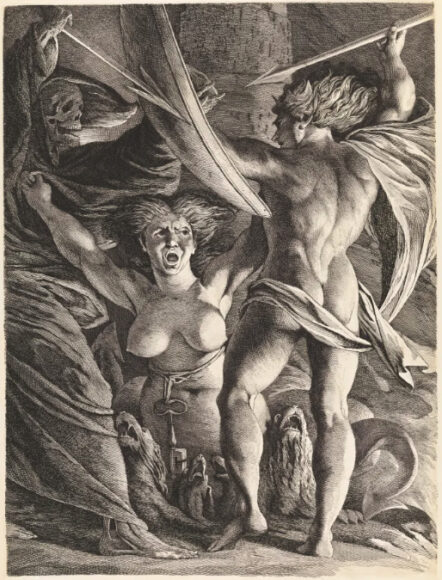
Satan is a regular visitor, popping up not only in Blake’s art, but also in the cascade of muscular devils pouring out of the skies in Edward Dayes’s The Fall of the Rebel Angels. And there he is again, glistening buttocks clenched sweatily, in James Barry’s wild-eyed etching of Satan, Sin and Death where Sin is, of course, a robeless and top-heavy 18th-century version of Jayne Mansfield.
In a show overflowing with writhing figures, few manage to hang on to their clothes. Everybody’s thrusting, twisting, poking out. But when it comes to sex, the artists of the Blake era are a particularly joyless bunch. What they are recording is wickedness, not pleasure.
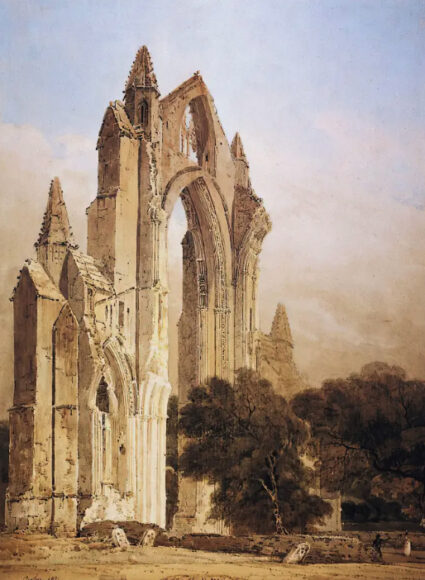
Their landscapes, too, are unhappy. Unable to travel because of the European conflicts that mark the era, they tour Britain instead and stare doomily at the battered ruins of the national past. Thomas Girtin goes to Guisborough Priory in Yorkshire and finds a looming gothic tower that would not look out of place in a Hammer horror film. William James Müller visits Stonehenge and sees the huge stones staring down at him like unclimbable cliffs.
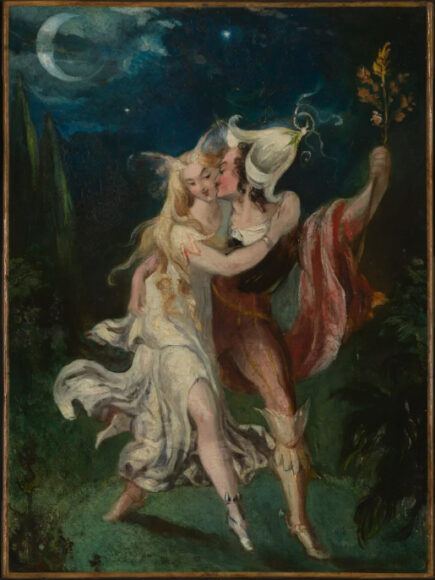
Where these dark imaginations are tested most severely, however, is at night, when the monsters and fairies come out to play. Theodor von Holst gives us a pair of kissing leprechauns, waving flowers at the moon. John Hamilton Mortimer, the show’s finest discovery for me, is a master at imagining brutish and disfigured physiognomies.
It’s entertaining stuff. And it results in a journey that feels less claustrophobic and more varied than most Blake events. Instead of peering through magnifying glasses at postcard-sized outpourings of knotty religiosity and creepily detailed micro-invention, as most Blake displays force you to do, you can roam here with your shoulders thrown back and your eyes bombarded by bigger sights.
But in this zoo of ungodly monsters, no one is quite as good at imagining the unimaginable as Blake himself. Skilfully and effectively the show weaves him into its larger picture. It’s a journey that starts with his death mask making a spooky appearance in the opening room. The version seen here used to belong to Francis Bacon, and, we’re told, never left his studio. Here as well it feels talismanic and tone-setting.
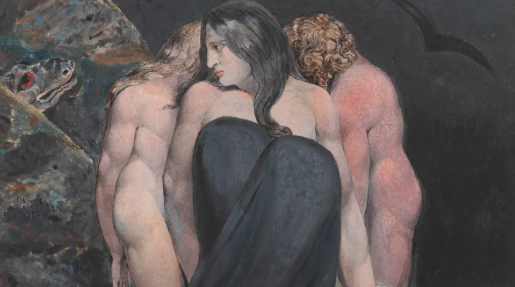
The early Blake watercolours selected from the Tate Gallery’s huge holdings of his work have a bigness to them that feels effective: less microscope, more telescope. God only knows what is actually going on in The Night of Enitharmon’s Joy — who’s Enitharmon, where’s the joy? — but the combination of huddled nudes and staring owls, donkeys and bats is stickily unsettling: Humanity v the Unknowable.
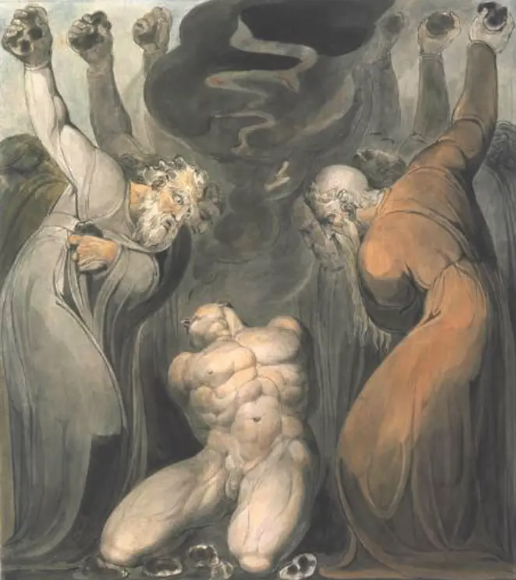
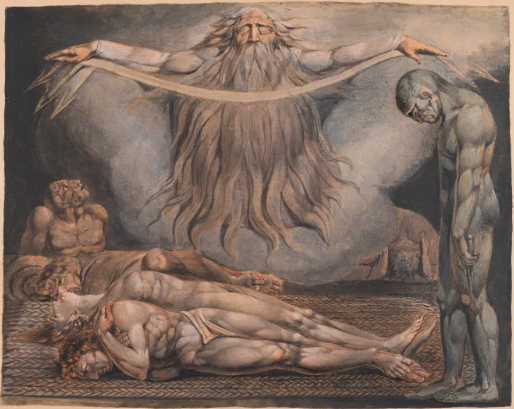
The Blasphemer, from c 1800, is an image of unusually tangible violence. A twisty nude male, his head thrown back in fear, is being clubbed to death by a ring of bearded patriarchs who have escaped from the Bible like the cast of Night at the Museum and are unleashing their demented anger, loathing and retribution on the unlucky sinner.
It’s powerful art. Indeed, Blake on his own has never affected me as powerfully as he does in this revealing mix of him with others.
William Blake: The Age of Romantic Fantasy is at the National Gallery of Ireland, Dublin, to Jul 19