Have you been thinking recently about René Magritte? Me neither. It’s not that he’s been cancelled or branded a lesser presence, but in recent times there has been no reason to remember him.
His dates, 1898-1967, do not add up to an obvious anniversary or peg. Museums have not, therefore, been showing him. Global aesthetics have not been celebrating his methods in any direct way. Like one of his own bowler-hatted chappies raining down from the sky, he’s a little man lost in the crowd.
So the Gagosian Gallery deserves a round of applause for suddenly confronting us with him — lots of him — and for making him the subject of an unexpected tribute. It’s a Magrittish thing to do! Yes, the market in late Magrittes, of which there are too many, probably needs a boost, but with so much invention being displayed at this surprise visit the market manipulation is easy to forgive.
This Is Still Not a Pipe: The Afterlife of Magritte, as the event wordily styles itself, is a 70:30 show. Seventy per cent of the exhibits are by Magritte, including some of his best-known early works, while the remaining material is supplied by a random gang of artists who can be said to have been influenced by him. If you squint.
We’ll come to the acolytes because they too have a tale to tell, but first we need to deal with the giant apple in the room — Magritte himself. Indeed, the outsized apple is one of the exhibits included here (The Listening Room, 1958), and although we know the image well from reproductions and album covers it still packs a punch. I found mild sensations of claustrophobia tugging at my throat at the sight of it. Even a picture as familiar as this probes beyond what the eyes can see. It’s Magritte’s secret power.
Perversely, he has always been rated the most lightweight of the surrealists. His clever picture puzzles — night skies turned to day; women turning into fish; insides that become outsides — have none of the psychotic force of Salvador Dalí or the mental violence of Hans Bellmer or Luis Buñuel. Where they shock, Magritte amuses. Or at least he seems to.
However, as I learnt on a trip I once made to his home town of Charleroi in Belgium, “the ugliest city in the world”, hiding beneath the jokiness is stuff that is dark and unsettling. This event seems often to probe for that disquiet.
You feel it in his 1928 portrayal of his wife, Georgette, posing naked with an assortment of unlikely objects arranged along her body, in a picture entitled simply Reclining Nude. It’s Magritte’s version of a classic Renaissance subject, but where others sought titillation he finds disturbance. Poor Georgette looks as if she has been forced to undress and lie there with a wine glass balanced on her belly button and a phallic bedside lamp on her crotch.
The story of Magritte’s mother taking her own life in a river near Charleroi and her body washing up naked with her nightie wrapped around her head is a key component of the Magritte origin myth. I found myself remembering it in front of several of the pictures displayed here. Not because of any specific pertinence, but because of the dark chimes of its mood.
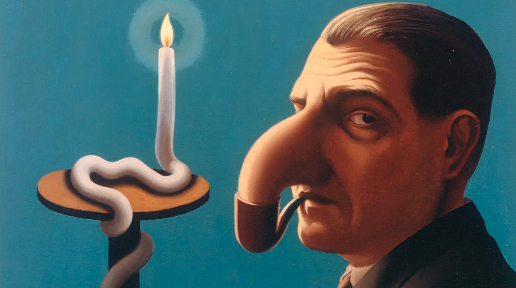
The weird painting of a man’s nose drooping into a smoking pipe while rhyming with a melting candle (The Philosopher’s Lamp, 1936) felt twistier and darker than I remembered it. So did the pair of boots turning into human toes (The Red Model, 1948). The banal objects grouped together in a display case (One Night Museum, 1927) describe the kinds of souvenirs a serial killer might keep.
It all serves to make Magritte feel weightier and less disposable than we generally assume. And the second thing happening here, the resuscitation of his late work, is also approached spunkily.
The usual story we are told, that after 1948 when he entered his période vache (cow period) his art went downhill, is both supported and challenged. The période vache has Magritte looking at too many Disney movies, making his work cartoonish and severing its spooky relationship to reality. The examples included here of pure période vache are unsaveably ghastly.
But so hated was the big change that it did not last long and although Magritte’s return to his first style never touches the heights of his early blast, it had its moments. Pictures such as The Leader of the Band, from 1955, in which a squirrel arrives in a forest on a flying breadboard, or The Well of Truth, from 1967, the bronze cast of the leg of a nondescript Belgian salary man, remain pleasingly inexplicable.
It’s a decent blossoming, helped here by an inventive and busy installation that makes the whole show come at you in a rush. What though of the followers?
That tale is, alas, largely dismal. Few of the disciples feel as if they really are paying homage to Magritte. Any artist with a taste for unreality appears to qualify. Only a handful survive the comparison.
Sarah Lucas is incapable of looking ineffective in a show. John Currin’s cartoony strangeness might even be said to strike interesting notes of période vache. And it’s right to see Jeff Koons included. Among the discoveries, Soshiro Matsubara is evidently a player. But that’s about it.
Staying in the slipstream of Magritte is obviously a lot harder than most of these exhibitors realise.
This Is Still Not a Pipe: The Afterlife of Magritte is at Gagosian Grosvenor Hill, London, to Dec 12; gagosian.com