Until 15 years ago, few people in the art world had heard of the Swedish artist Hilma af Klint. She wasn’t in books, she didn’t have shows, she wasn’t on people’s lips. Today she is widely written about, widely shown, widely adored as a key figure in modern art. From nowhere to everywhere in a couple of decades. It’s a 21st-century fairy story.
The af Klint tribute that has opened at the National Gallery of Ireland in Dublin does not delve into the details of this rise, but by presenting us with a wider view of her career than the one delivered at previous events it allows us to conclude she was both less impressive than we are habitually told today, and more. Depending on where you look.
Why is she celebrated so fiercely? Because — drumroll — Hilma af Klint (1862-1944) is said now to have been the first abstract artist. It’s a mantle that may not sound especially impressive outside the art world, but inside it elevates her to Einstein levels. Chiefly because it plucks the honour away from the male artists who had previously tussled for it. Until af Klint was discovered, Wassily Kandinsky, Piet Mondrian and Kazimir Malevich had been variously cited as the takers of the giant leap.
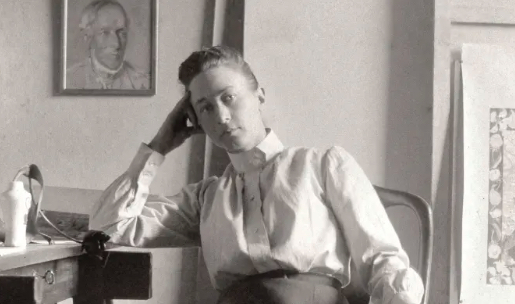
There’s more. Af Klint’s adventures in feminine abstraction were prompted by a set of beliefs that in earlier times could be filed uncontroversially under “wacky”. The extensive occult studies she undertook were once viewed as nutty departures from the road to reason. This is no longer true. Today the paths of magic, witchcraft and spiritualism that she followed have metamorphosed into serious art directions. It’s a hugely significant shift.
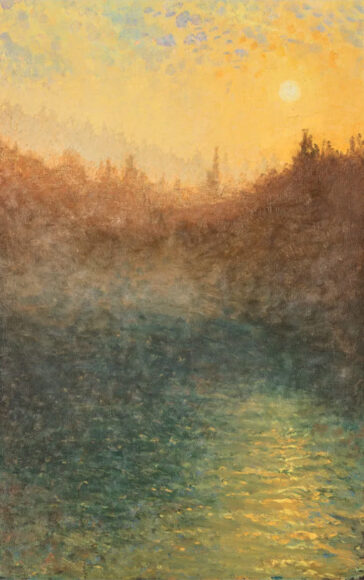
That’s the context. What about this show? When we encounter her here, she is still a student at the Royal Academy of Fine Arts in Stockholm, drawing nudes, painting landscapes, attempting portraits. And the student art offers pleasing evidence of heightened artistic talent. The portraits are warm, the landscapes poetic.
What I liked most, though, were her still lifes. An eerie set of three drawings showing a vase, a lamp and a spiral staircase manages to prompt sensations of unreality. They are so still, so perfectly drawn. To suggest that they predict a paranormal path is a projection, but there’s definitely something spooky about them.
Being reminded that af Klint was a talented artist before she became an exceptional one is useful and telling. So are the expanded details of her origins. She came from a naval family with money and status. The “af” bit of her name was the Swedish equivalent of “de” in France or “von” in Germany — a titular elevation to the ranks of the posh.
She never had to support herself. Which left plenty of space for her thoughts to wander across the assortment of paranormal beliefs that popped up during the 19th century’s angsty fin de siècle: spiritualism, theosophy, Rosicrucianism. She sampled them all.
Joining four other women in a spiritualist collective called the Five, she began making art in extraordinary circumstances. Ignoring her artistic training, she began painting at séances, allowing the forces beyond to guide her brush. No longer the artist, she was now the conduit for a ghostly directorial cast known as the High Masters.
The key examples here come from the 193 paintings she produced between 1906 and 1915 for a building project called the Temple. Shaped like an ascending spiral, the Temple was to house an unfolding sequence of pictures devoted to af Klint’s noisy spiritual divinities.
The earliest attempts we see are, alas, ghastly. While the first still lifes are unexpectedly impressive, the first magic pictures are unexpectedly crude. Consisting of cod diagrams packed with figures, words, numbers, flowers, they track the paranormal path to enlightenment with an absence of elegance that makes a snakes and ladders board look graceful.
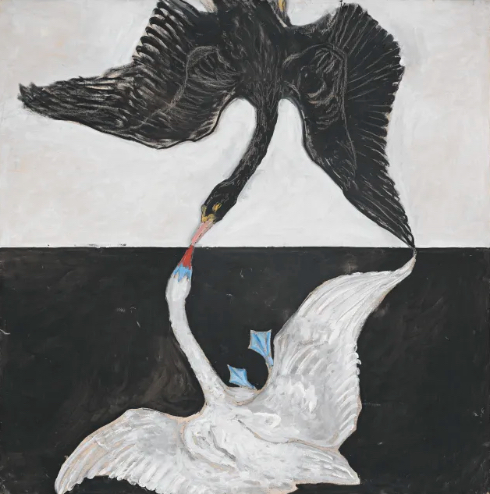
But as she climbs the spiral, af Klint learns to simplify. The work grows less diagrammatic, larger, bolder, brighter, until we arrive at the three huge pictures that were to form the summit of the Temple in a triptych called The Altarpieces.
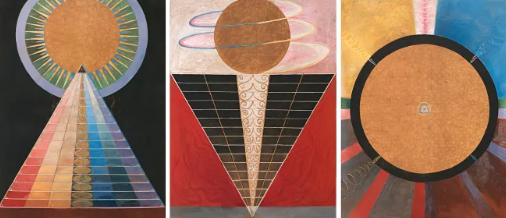
They are impressive because they manage to be both full of mystic symbolism and simple to look at: some triangles, some circles, some cosmic divides. If you hadn’t followed their esoteric past so closely it would be easy to take them at face value as pleasing bits of geometry.
It’s worth remembering too that the other claimants to the title of the first abstractionist — Kandinsky, Malevich, Mondrian — were also prompted by esoteric beliefs. The accusation sometimes levelled at af Klint that she was on another path, a path that doesn’t qualify as art, is sexist as well as unfair.
The Dublin show also makes clear that she never abandoned the traditional path. Indeed, on this evidence the moments of pure abstraction were an anomaly, and the traditional path was the norm.
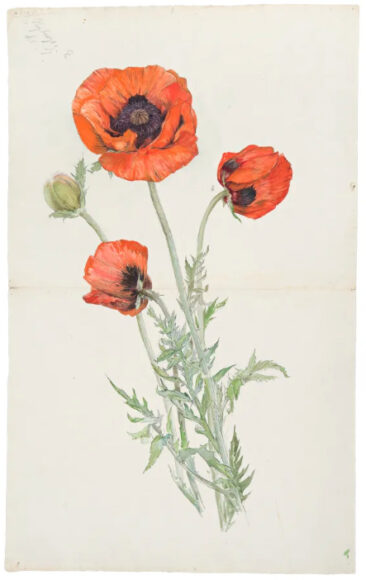
The show ends with a room filled with beautiful watercolours of flowers and coloured skies made under the influence of the ubiquitous Rudolf Steiner, the inventor of anthroposophy and chief Germanic prompter of 20th-century hocus pocus.
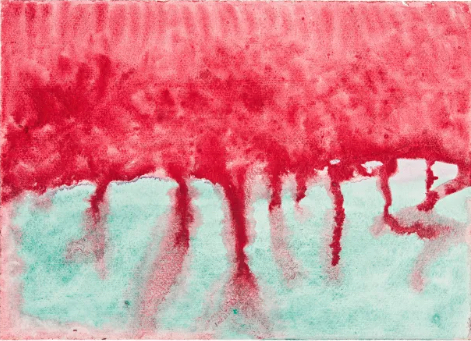
Working with watery paints that soak naturally into suggestive blots and rings, af Klint, in her final decades, dials down the volume of the Temple pictures and creates a quiet body of work centred on the example of nature. It’s her best and dreamiest art.
Gazing into my crystal ball, I predict this gentler version of Hilma af Klint will increase in reputational size and eventually eclipse the first abstractionist.
Hilma af Klint is at the National Gallery of Ireland, Dublin, to Feb 7