Fast-forward to the end of Donald Trump’s presidency. The Strait of Hormuz is still blocked. In America the price of diesel has gone up to $15 a gallon. In Saudi Arabia the Houthis have bombed Riyadh for the fifth night in a row.
Fearing for his life, Trump converts the billions he made during his presidency into gold — which is trading at $12,000 an ounce — and escapes to Russia, where he’s given a red-carpet welcome by Vladimir Putin and set up in a dacha on Lake Valdai next to Edward Snowden and across from Kim Philby’s old place.
One morning a parcel arrives addressed to “Tovarish Donald, Peace Prize Winner”. Trump opens it excitedly, and finds he’s been sent a celebratory bottle of Russian perfume. He takes a whiff and pulls out an AI translation app and spells out the letters one by one. “N… o… v… i… c… h… o… k…”
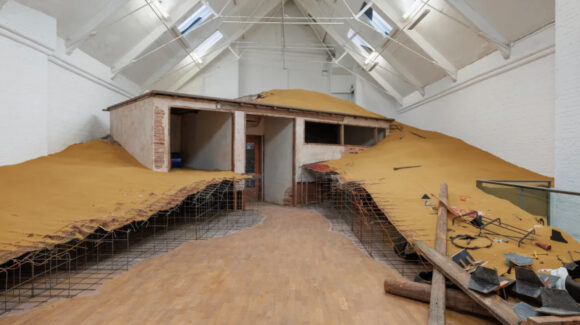
Excuse the fantasising. I’ve just been to see Mike Nelson’s new installation at Modern Art Oxford, and his work is designed to stir up conspiracy theories. His art kidnaps your everyday moods and plunges them into scary exile in a spooky underground basement where nothing makes sense and everything causes unease.
Called Double Negative (The Clown), the installation feels as if it might be located somewhere in the Middle East. On the outside it’s covered with sand, like a secret tunnel that’s been dug in Gaza or perhaps somewhere in Iran where the new ayatollah has been hiding out. The wooden entrance feels unsafe, but you go in anyway for the same sorts of reasons that you go on ghost train rides at the fair. There’s something about beckoning subterranean darknesses that we humans find irresistible.
Whoever lived in the sandy bunker before isn’t there now. They obviously had to leave in a hurry. The lights are still on. The room where they stored their explosives has been left in a mess. The telecommunications hub where they listened in on the world’s political chatter and intercepted Pete Hegseth’s WhatsApp messages is still operating but locked.
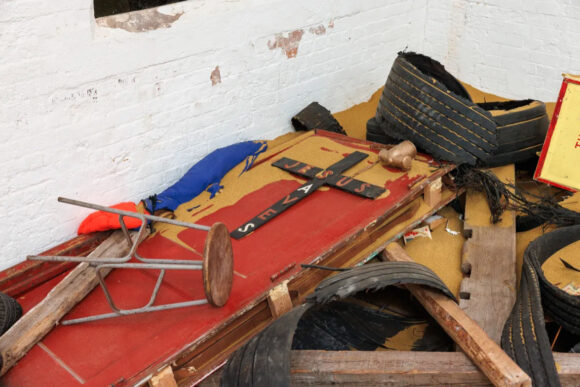
Knocked up impressively with superior DIY skills by Nelson, the nervy underground complex encourages you to wander through it — down corridors, through doors, into rooms — seeking answers but never finding them. It’s like being stuck in a video game, advancing from level to level, mystery to mystery, then being spat out at the end, filled with suspicion but none the wiser.
To help to make sense of the creepy environment he has built for us, Nelson has added homemade labels at the exits in which he tells us in complex Nelson-speak what he is trying to do. Unfortunately, Nelson-speak is every bit as shifty as Nelson art and no amount of intense reading clears anything up fully.
Having read, reread and triple read the labels, I believe the point he is trying to make is that the mad conspiracy theorists who used to be the subject of his creepy installations — the Unabombers and QAnon crackpots — have become presidents, dictators and ayatollahs and taken over the world. Yikes. Please, Mr Unabomber, can I share your bunker with you?
Still in Oxford, and still in the world of hopeless fantasy, the Ashmolean Museum has mounted a show devoted to the Greek goddess Aphrodite. Better known, probably, by her Roman appellation of Venus, she’s the goddess of love and has in the course of her divine reign caused incalculable amounts of strife, jealousy and turmoil in our love-hungry human world.
The show, a wonderful one, tells her story from its ancient origins to its dodgy present relevance with an exciting array of artworks and mementos. Thus we go from prehistoric Cyprus to posthistoric Beyoncé in a whistle-stop tour of the constantly badgered, constantly updated, constantly exploited human libido.
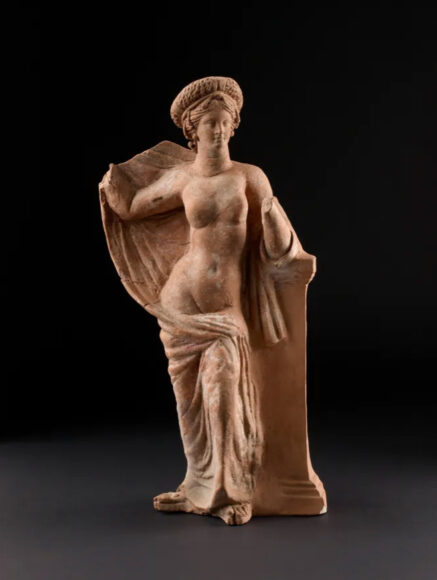
Aphrodite began life as an all-powerful Cypriot deity called simply “the Goddess”. As such she was the heavenly force behind every aspect of human existence, especially our survival. Thus, she became the deity ancient Cypriots prayed to in matters of fertility and reproduction. A cast of tiny but potent ancient statuary shows her suckling babies and offering them her milk-filled breasts. Lots of nurture. No titillating sex.
All that changed when worship of the Goddess overflowed into the wider Greek world and she became Aphrodite, the goddess of love, a deity over whom ancient male sculptors could frequently and merrily salivate. The watery origins that were imagined for her had her being born in the ocean from the frothing sperm of the castrated testicles of Uranus. Sex and darkness became her problematic attributes.
By the time the Romans got their hands on her and renamed her Venus, she was transformed entirely from the original Cypriot mother goddess into mythology’s leading pin-up. She was famed for her perfect beauty and the celebration of her looks resulted in a huge tonnage of sexy art.
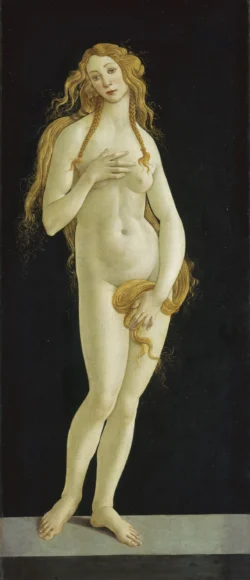
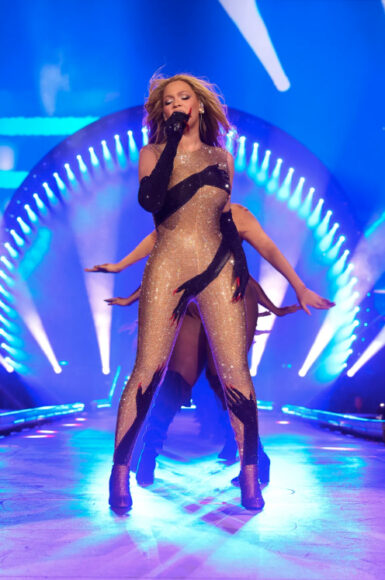
Botticelli’s Venus will never, of course, be lent by the Uffizi Gallery, but we do get a school of Botticelli goddess who does the same job gorgeously, and, to round off her descent into divine one-dimensionality, Beyoncé pops up as well to cavort on stage in a revealing outfit inspired by the Venus de’ Medici.
Thus Aphrodite’s journey from all powerful ancient goddess to Instagram-friendly costumier for the queen of pop is complete.
Mike Nelson: Double Negative (The Clown) is at Modern Art Oxford to Apr 11; Aphrodite is at the Ashmolean, Oxford, to Apr 11