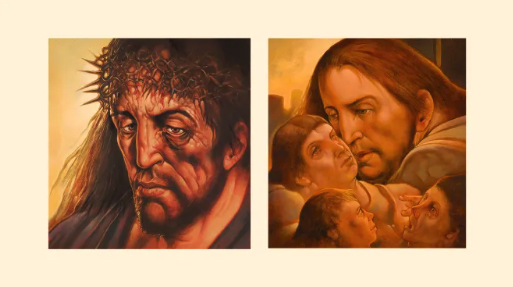
If they handed out VCs to artists for courage then Peter Howson would be marching out of Buckingham Palace tomorrow with that rarest of gongs pinned to his chest. Because no subject in contemporary art is as strikingly uncool as the one he tackles in his new show at the Flowers Gallery. The show — roll the drums — is all about Jesus.
There was a time in art when painting Jesus was perfectly normal. But you need to go back a couple of centuries to find the last epoch when this was true. In today’s art, celebrating the “belief systems” eradicated by western missionaries — voodoo, witch doctory, nonhuman animism — is eminently fashionable, but going in the opposite direction and doing a Cliff Richard is a big no-no.
So the first thing to note about Howson’s sweaty display is that it feels tangibly discomforting. Even before you enter the gallery, a glistening Crucifixion hanging in the window tempts you to scarper. It’s like that Scientology shop in Tottenham Court Road where you run for your life from the smiling church members trying to entice you in, because you might turn into Tom Cruise and never come out.
With Howson, the artistic enticements are powerful enough to pull you through the door. He may be 200 years behind the times, but boy can he draw. Besides, the Crucifixion in the window has a filmic sheen to it, a veiny muscularity you’ve seen before in Sylvester Stallone films. Something noisy is taking place in Howson’s Salvation show. So in you go.
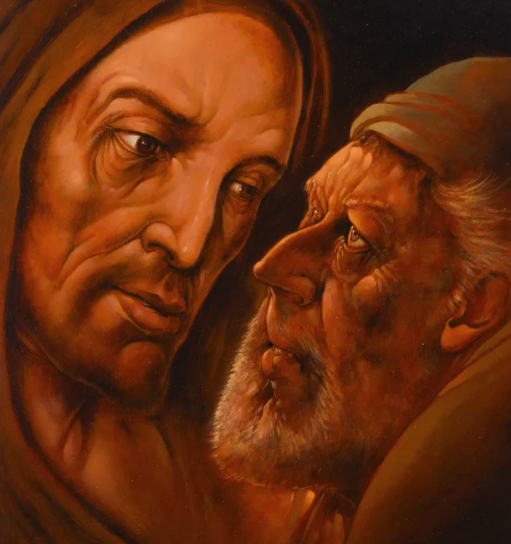
Awaiting you is a ring of small images showing episodes in the story of Jesus. They surround you like the stations of the cross in a Catholic church. In this instance, though, the timeline of Christ’s Passion has been jumbled up. Over here he’s being betrayed by Judas. Over there he meets Mary Magdalene in the garden. And there he is again being crucified.
Not only has Howson reordered the story, he presents it in extreme close-ups that take you so near to the action you feel you are being splattered with Jesus’s sweat. It’s a prickly experience and not at all pleasant. But it is strikingly original and deserves some attention.
First, a quick look back at Howson’s life. It’s pertinent. At 19 he joined the army, but only lasted a year. At 21 he enrolled at the Glasgow School of Art, but dropped out. Setting himself up as an independent painter, he emerged noisily in the early 1980s as one of the “New Glasgow Boys”, who were having their big moment in art.
In 1993 he was sent to Bosnia as Britain’s official war artist and painted scenes of unimaginable terror and violence. It led to a nervous breakdown. To forget what he saw he turned to drugs and booze. In 2000 his addictions put him in hospital. In 2001 he found Jesus.
As a life story it’s markedly different from the ones you generally encounter in art today. And it surely explains the white-knuckle intensity of his visions. The Jesus we encounter here has been plucked out of the Bible and deposited in a spotlit Sarajevo.
When a legion of grinning demons attacks him in the dark, he clouts them away with biceps worthy of the young Arnold Schwarzenegger. When he hangs on the cross, he’s such a big unit you expect the cross to start leaning perilously. Nothing happy or clappy is allowed to dilute the fierce and sweaty religiosity of these bellicose little pictures.
What saves all this from ludicrousness is his evident skill as a painter. The sureness of his touch is highlighted in the studies for the paintings that accompany every image. It’s a pleasing pairing. The drawings are gentler and quieter than the paintings. Their softer tone brings down the noise levels and takes us closer to religious atmospheres centred on warmth rather than angst, love rather than conflict.
A shallow step for womankind
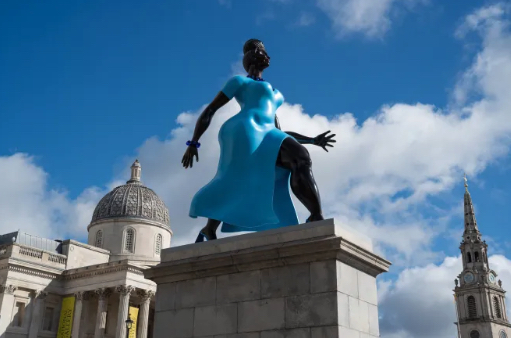
In Trafalgar Square the latest artistic effort to sit atop the Fourth Plinth has been unveiled. Unfortunately the new contribution, by Tschabalala Self, is one of the worst so far.
Its problem is that it’s so damn shallow. The Fourth Plinth has been a huge success because it brought ambitious contemporary art to this most public of spaces. But those days are gone.
Instead, Self gives us Lady in Blue, a giant galumphing female whose ungainly stride looks to have been borrowed from the cartoon women drawn by Robert Crumb: the ones with huge bums and pouty breasts regularly accused of misogynist sexism. She also bears a passing resemblance to Mammy Two Shoes in the Tom and Jerry cartoons, the black servant who chases them round with a broom.
Of course, Self is after something else. The argument goes that her galumphing woman represents “everywoman”, the ordinary citizen who does not usually appear on plinths but who is more deserving of a place in Trafalgar Square than kings and admirals.
To underline that ambition, her jokey figure has been painted Primark blue, which, ludicrously, is compared to the lapis lazuli with which old masters used to signal the presence of the Virgin Mary in art. This particular blue looks more like the colour of the Ford Anglia my stepfather used to drive round Reading.
What we have here is simplistic imagery prompted by simplistic thinking. This dumbing down of the Fourth Plinth is not a big surprise, but it is a big disappointment.
Peter Howson Salvation, at Flowers Gallery, London, until Oct 10