In the age of reproductions, it is the fate of some artworks to be so well known that we no longer know them. It’s happened to the Mona Lisa. It’s happened to the Girl with a Pearl Earring. Their outsides have hardened into such familiarity that they block our access to their insides. The same process, with a particular twist, has damaged the reality of the Bayeux Tapestry.
The twist is that the tapestry has popped up relentlessly, not on the covers of art tomes and museum posters, but on page 10 of every history textbook ever opened in every classroom in Britain. Every schoolkid has at some point found themselves staring at the image of King Harold of England with an arrow in his eye, and instinctively recognised their homework. It’s a tough memory to dislodge.
So the first, and perhaps the most important, thing to say about the British Museum’s presentation of the great medieval comic strip is that it has resulted not just in a thrilling show but also in a thrilling rescue job. The BT needed saving from the history textbooks. The BM achieves it heroically.
From the moment we step into the giant art barn in which it is being shown and confront the absurd scale of these sewings — 230 feet of uninterrupted Anglo-Saxon creativity stretching far into the distance — the wows are impossible to suppress. Everything about the smart presentation of the tapestry’s return to England after 900 years of French exile succeeds in promoting its identity as a spectacular artwork, rather than a handy record of history.
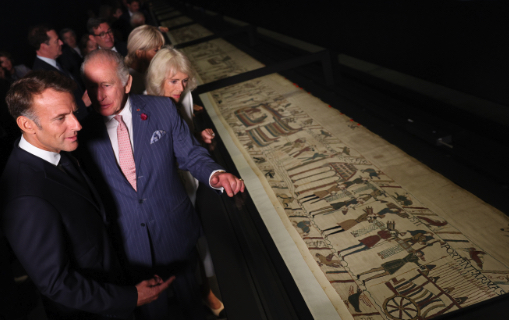
In Bayeux itself, in the lonely museum where some of us have seen it before, all alone with our exam fears, it was folded into a U-turn and felt much smaller. Here, examining its leaps and lurches takes you to your daily 10,000 steps. What a monster of outrageous medieval inventiveness it is.
Most visitors will enter the show with the date “1066” stamped into their memories and a blurry recall of the Norman Conquest that followed. It’s a date and a circumstance that sits near the head of Britain’s origin myth. We were Anglo-Saxons. The French conquered us. We turned into an international blend.
In reproductions the style and simplicity of the telling of this tale by the tapestry is close enough to the manner of the modern comic book to give it an easy legibility. In educational terms it’s very useful. But what we cannot get from reproductions, what this event unleashes so viscerally, is the drama of the conquest’s unfolding, the unexpected modernity and quickness of the characterisations, the unexpected moments of temporal leaping, the madcap twists in the margins, the fun being had by the sewers. Those are successes not of record keeping, but of art.
Wool stitched to linen has not generally been lauded as a thrilling art material in modern times. We’ve preferred oil paints or welded metals, point-and-click photography or the free assembly of assemblages. But, owing to the efforts of female art historians and curators, there’s been a swing in these values. Textile art of all kinds, produced inevitably by women, often glowing with notes of domesticity, has leapt up the leaderboard. And, right on cue, the Bayeux Tapestry has appeared noisily among us to bang home the point.
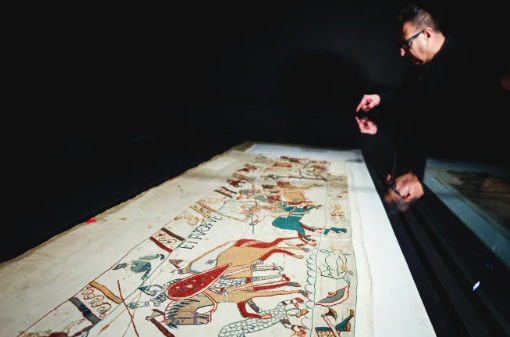
It’s shown here lying flat, not tacked droopily to the wall as it was in Bayeux. So we are able to lean over the extravagantly long glass cases and examine it in intimate detail. It’s a presentation that prompts endless little excitements.
Among the surprises is the level of characterisation that can be achieved with the skilled wielding of a needle and thread. Every time Harold pops up in the story he looks different. Every horse ridden by the invading Normans has an identity of its own. The buildings are inventively imagined. The trees separating the scenes are wonky to the point of surrealism. And see the range of expressions, from happiness to subservience to anger, indicated with such exquisite economy on the faces.
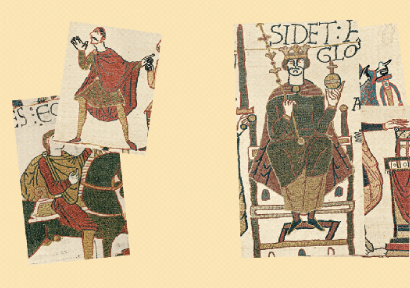
Nowhere do we see standardisation or lazy repetition. The process of communal sewing that went into the creation of the tapestry, probably by a battalion of top female stitchers based in Canterbury, in or around the 1070s, simply does not allow it.
The story of the invasion is told in three sections. Part one details the events involving Harold that lead up to the rift with William the Conqueror. Part two, the most dramatic and powerful, gives us the invasion itself with its huge cavalry charges and the copious littering of corpses. The style might be medieval but the tone and bigness could almost pass for something baroque. What a noisy battle.
Part three, the ending, is both sudden and problematic. Harold has been killed at Hastings. So the entire tapestry seems to fall off a cliff. We see the victorious Normans chasing the retreating English. A cocky Latin caption announces “And the English fled”. And that’s it.
Surprisingly the BM’s exhibition texts and related tomes are noticeably sanguine about this abrupt ending, and even suggest that it might reflect the original journey. But, in the flesh, in the show, the amputation is clear and disrupts the rhythm of the tapestry. There must have been more. And, as the scholars speculate, the action probably concluded with William’s coronation at Canterbury.
It’s something else to puzzle over in an artwork packed with mysteries that feels as if it has finally and belatedly come home.
The Bayeux Tapestry is at the British Museum, London, until Jul 11, 2027