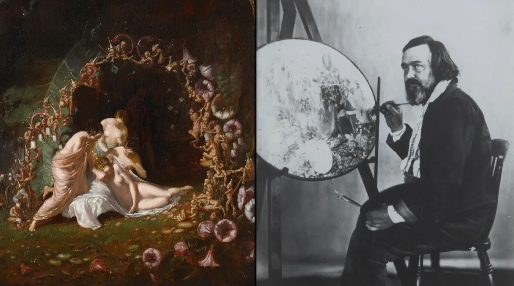
Death. It’s the most final of finalities, its presence so concrete no amount of good intent can blow it away. However diligently the Royal Academy tries to present Richard Dadd as an intriguing Victorian fairy painter, and that’s it, the fact that he murdered his father, believing him to be the Devil, cannot be wished off. It’s there at the start of the show, the middle, the end and every step in between: a cold touch on the back of the neck.
Poor Dadd. With modern understandings we now know him to have been a paranoid schizophrenic, but his times were less familiar with the subtleties of the mind and, once he was hunted down for the murder, he was sent first to Bedlam, then Broadmoor — a painter in a madhouse, producing images so extraordinary they appeared, in most cases, to confirm his insanity. Or even to enlarge it.
It’s such a strange story. It begins in Chatham in Kent, where Dadd was born in 1817, the son of a chemist. Somewhere along the line, the family’s genes had been twisted out of true because two of his seven siblings had the same condition while a third needed “a private attendant” for mysterious reasons.
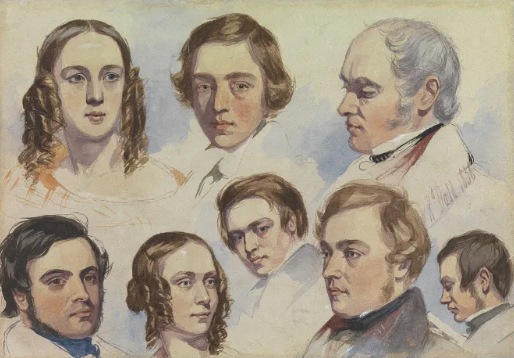
Yet the show begins with what appears to be a happy family. In a watercolour from 1838, Dadd presents his father, himself and his many brothers and sisters as a group of confidently observed heads. Putting aside the high proportion of unbalanced minds we see here, what really impresses is the swiftness and sureness of Dadd’s touch. The eight heads are dashed off, one after the other, with real bravura.
At 20, he joined the Royal Academy Schools, an obvious talent. But it’s about now you start feeling the cold touch on the back of the neck. One of his earliest RA paintings is a portrait of his fellow painter Augustus Egg, who, for reasons lost in the canyons of history, is presented by Dadd as a 17th-century Puritan soldier. With his stovepipe hat and a murderous determination in his eyes, Dadd’s Egg looks as if he might just have decided to behead Charles I.
The early work is but an amuse-bouche for the show’s second section: the fairy paintings. The Victorian fondness for fairies is one of those shipwrecks of taste that puzzles foreigners about the British. How could all these sensible, hard-working, strait-laced realists suddenly develop such a fierce appetite for hobgoblins?
What’s certain is that Dadd was, immediately, the best of the fairy painters. His first masterpiece, Titania Sleeping, from 1841, is as beautifully done as it is completely bonkers. Borrowing no more than an enchanted atmosphere from Shakespeare’s A Midsummer Night’s Dream, it shows a sweetly dreaming and nude Titania encircled by battalions of furiously writhing gremlins, imps, sprites and gnomes in a monstrous cave made of giant bats.
Dadd painted half a dozen stand-out works. The sleeping Titania surrounded by her nightmares is definitely one of them. His talents were so obvious that a moneyed politician, Sir Thomas Phillips, decided to take him as an official draughtsman on a grand tour of the Middle East.
Thus Dadd found himself visiting Venice, Istanbul, Damascus, Jerusalem and Cairo. Somewhere along the way, the baking sun and the pungent hookahs tipped his fragile mind over the brink. On a journey down the Nile he began to believe he was the son of the Egyptian god Osiris and that angry devils were on his tail.
The actual art he produced on the journey is unexceptional. His sketchbooks are filled with predictable bazaar scenes and views of camels. But something serious had snapped. Just a few months after his return he slashed his father’s throat with a dinner knife. While attempting to escape to France he attacked another traveller with a razor and was caught and dispatched to the mental asylum of Bedlam.
It was where he painted his most celebrated works. The RA has done conspicuously well at filling out his story with lesser examples. But the aforementioned half a dozen great paintings took him so long to produce and are packed with so much detail, they remain his main achievements.
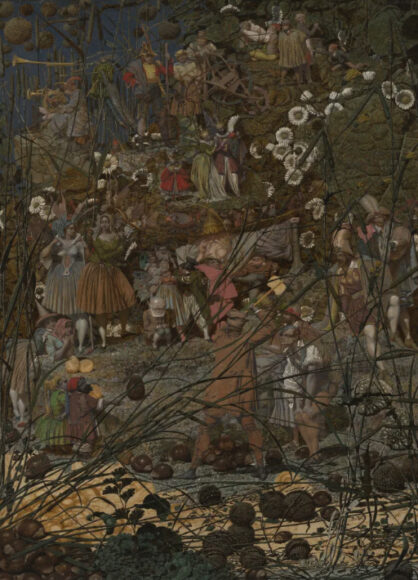
First in line is, of course, The Fairy Feller’s Master-Stroke, that tiny Tate masterpiece packed with gurning forest folk that took Dadd almost ten years to paint even though it’s barely larger than a Corn Flakes packet. The central moment here, the fairy feller cracking a giant nut with his mallet, is mobbed by so much madcap action it’s genuinely difficult to isolate.
Nuttier still is the biblical scene he finished in 1850, The Flight out of Egypt. At least that’s its nominal title. In truth, the impenetrable mass of Egyptians, Bedouins, African tribalists, Jewish patriarchs, Roman soldiers and Arab camel dealers crowding round an extremely unlikely Mary and Joseph with the baby Jesus is a pioneering Victorian example of Where’s Wally art.
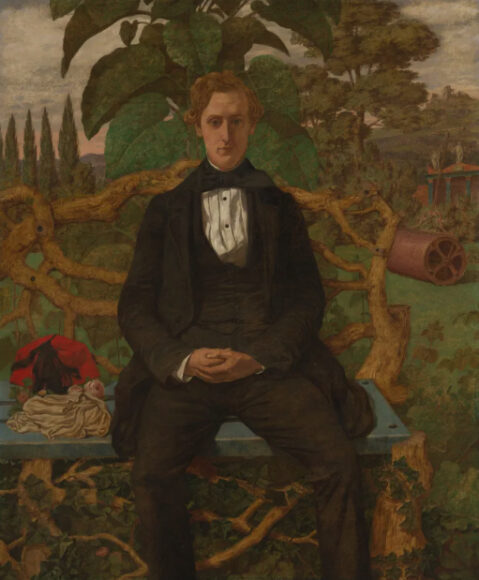
Even in his quieter moments Dadd manages to infect his work with strangeness. In the unsettling painting called, deceptively, Portrait of a Young Man, he shows a glum Victorian lost in thought on a garden bench. Then you notice the details: the red fez on the seat next to him, the writhing plant creeping over the bench, the weird roller on the lawn behind. And the cold hand touches your neck again.
Here and everywhere at this stimulating and exciting event, you’re never sure if you’re seeing what’s there or furiously projecting. It’s part of the fun.
Richard Dadd: Beyond Bedlam, at the Royal Academy, London, until Oct 25