Warning: the following review will make most sense to those readers who were once hippies. Pink Floyd fans may enjoy some parts. And anyone who has read Steppenwolf by Hermann Hesse or Lord of the Rings.
Somewhere in the galaxy there is a planet inhabited by crazy woodcutters who enjoy puzzling the bejesus out of the other crazy woodcutters by producing impossible images. This mad planet decided to send one of its best practitioners to Earth to see if crazy woodcuttery could catch on here as well. But because our astronomers have not yet identified the woodcutter planet, the appearance of Maurits Cornelis Escher among us is classified as an unexpected turn-up, and that’s all. However, the Roswell Research Center is leading fresh research into the matter.
The intergalactic woodcutter once wrote: “Only those who attempt the absurd will achieve the impossible. I think it’s in my basement. Let me go upstairs and check.” Escher didn’t just think outside the envelope, he could not accept the existence of envelopes. Why contain when you can expand?
What’s certain is that the career mapped out by the Escher show that has landed at Somerset House takes us to places we do not usually go with art. And only those with hearts of iron will be able to suppress the excited giggles, squeals and oohs forced out of us by all this exposure to Escher’s ridiculous and brilliant imaginings.
According to the cover-up being investigated by the Roswell Research Center, ie the official Escher biography created for gullible earthlings, he was born in 1898 in Friesland, the northernmost part of the Netherlands. Nicknamed Mauk by friends and family, he was a sickly and sensitive child whose chief pleasure in life came from art. Enrolling at the art school in Haarlem, he studied “the decorative arts” under Samuel Jessurun de Mesquita, who may have been another escapee from the mad planet.
De Mesquita taught Mauk the essentials of producing woodcuts, a technique that had its heyday in the 16th century and had spent the intervening epochs being forgotten. Mauk took to it immediately. “Let us try to climb the mountain,” he would later instruct, “not by stepping on what is below us, but to pull us up at what is above.”
The earliest prints in the show — praying hands with extra-long fingers, an exploding sunflower — point firmly to an adventurous mind. From the off, his work felt charged. In 1921, the chronicles tell us, he visited Italy, a journey so fruitful he decided to stay and lived in Rome until 1935. What pleased him most was the spooky architecture of the Renaissance and that sense you get in Italy that thousands of others have previously stood where you are now standing.
Looking down from the clouds, he presents us with a scary bird’s-eye view of an impossibly tall tower that’s still being built, which he calls The Tower of Babel. In a crypt, on a medieval tomb, he finds a dead bishop lying supine with a giant praying mantis sitting on his chest, about to eat him.
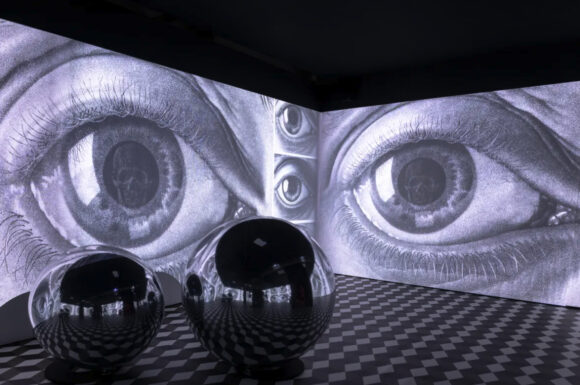
That was in 1935. Decades later, in the 1960s, dreamy travellers returning from Kathmandu would find in Escher a kindred spirit who could see inside their heads. Indeed, Pink Floyd and Mott the Hoople loved him so much they adorned their records with his imagery. The Somerset House show includes a psychedelic section devoted entertainingly to the dippy hippy responses to Escher. It’s interactive and lets you wander digitally though the canyons of his mind.
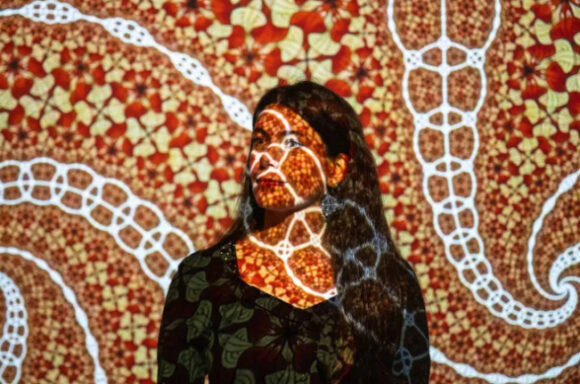
Escher wasn’t political but he knew a bad man when he saw one and the emergence of Mussolini in Italy made him angry enough to leave his beloved Renaissance landscapes and return to Holland. On the way back he visited Spain and was struck with admiration for Islamic art, especially the complex geometric interplay of tiles at the Alhambra in Granada.
His brother, a geologist, explained the intricate calculations involved in Islamic “tessellation” and from this point in the Somerset House show it becomes debatable if we are dealing with the wonders of art or the magic of mathematics.
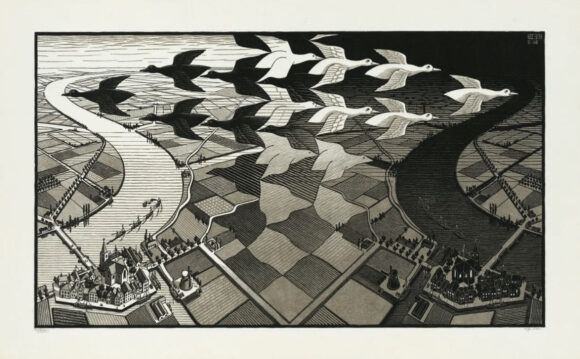
Shapes morph into other shapes. Hugely complex transformations ensure that fish become swans while night becomes day. And because woodcuts never lose their handmade mood, there’s a sense of ancient alchemical truth to this visual wizardry, as if you have encountered it in a lost medieval almanac on sorcery.
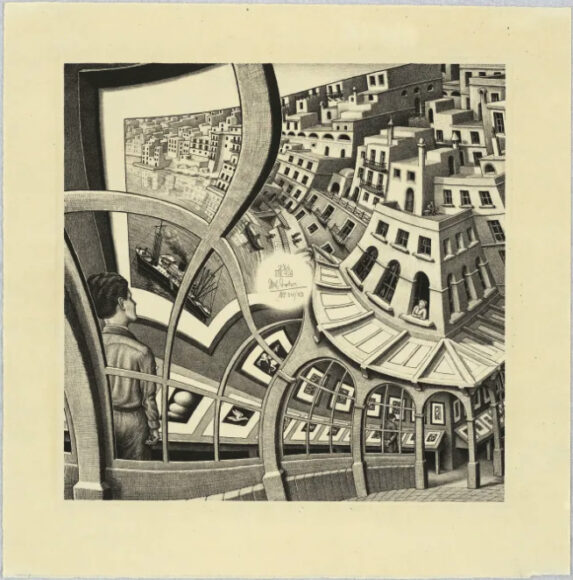
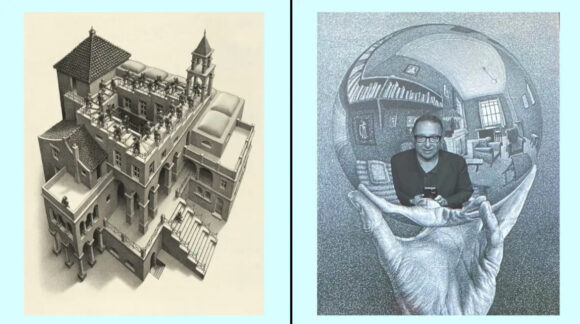
Fully aware of why we are here, and what we want from the show, the organisers dot your journey with puzzling things to do. One room you can walk into makes you look super-small while your partner looks super-large. In a wonky digital swap, you can transform yourself into Escher and take his place in a crystal ball.
All this is fun. But it’s the art that keeps slapping your mind around and forcing it to work out things that are unworkable. The final section features Escher at his psycho-artistic best, imagining eerie Islamo-Roman buildings that send you up ladders and down stairs in hopeless pursuit of an exit. Rivers flow ceaselessly upwards on looming aqueducts. Huddled monks trudge wearily round doomy cloisters on which they are elevated while descending.
I suppose we could call this surrealism. But the dates of Escher’s output, the 1920s to the 1960s, push him beyond surrealism’s usual boundaries. Nothing about him fits easily. Which is why I favour the extraterrestrial explanation. Remember Hobbits, not all those who wander are lost!
MC Escher. The Exhibition is at Somerset House, London, to Sep 6, somersethouse.org.uk