Every few years I decide to give the pre-Raphaelites another go. To forgive them their myriad sins, especially their cardinal failing, the sin of silliness, and to look again at their art with fresh eyes and an open heart. It never works.
On this occasion the show that tempted me into forgiveness sounded like a stimulating reread. Pre-Raphaelites: Art and Poetry at Laing Art Gallery in Newcastle promised new angles. Newcastle is always a stirring art destination. The Laing always prompts fondness. Above all, art and poetry really do go well together.
Both are essentially private pleasures. With both, there’s a sense of another imagination whispering deeper understandings to you: just the two of you, understanding together. And good poetry rarely makes the understandings immediate or easy. There are always gaps, journeys, leaps. As there are with art.
By teaming poetry with the pre-Raphaelites the Laing is, therefore, promising new depth and a telling union. Unfortunately, from the start the indestructible silliness looms up unmissably. As soon as you walk in, pulsing brightly on the wall before you like a piece of shouty Victorian neon is The Woodman’s Daughter by John Everett Millais.
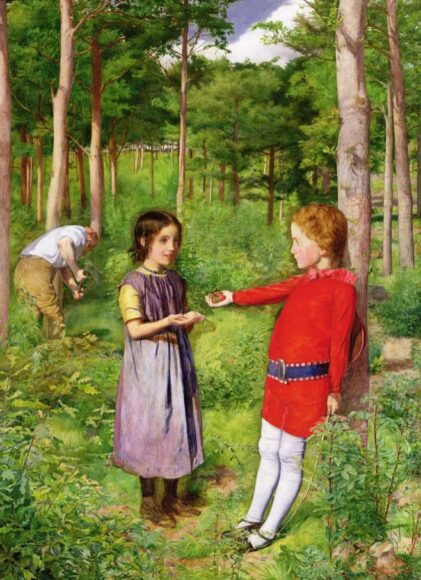
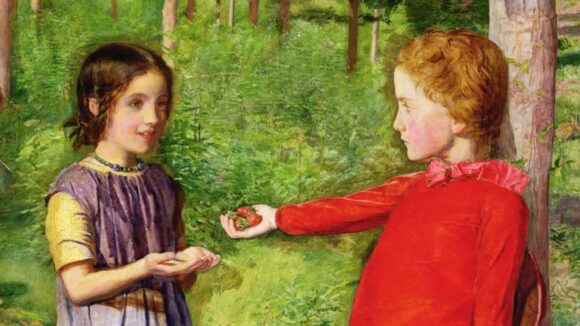
Painted in 1851, it features a pair of preternaturally young lovers whose preternatural love is, of course, doomed. The little boy, dressed in a crimson so bright it belongs on a phone box, is handing strawberries to a little girl in a shabby pinafore whose father is cutting down some trees behind them. The boy in red, Merton, is evidently rich. The little girl, Maud, is evidently poor. Oh dear.
The poem that prompted the scene, by Coventry Patmore (parts of it are appended to the adjacent wall, as they are with all the poetry here) goes on to tell us that he seduces her, she gets pregnant, he abandons her, so she drowns their baby in a river and goes mad. The action ends with Maud spinning wildly at her wheel, singing crazily.
So that’s what we’re dealing with here. Sentimental shlock masquerading as profound subject matter. True, the quality of the poetry improves notably as we progress through the event and encounter Dante, Chaucer, Shakespeare and Keats, but what never fades is the pre-Raphaelite obsession with doomed damsels or their predatory concern with adoring them and saving them.
On the plus side of the ledger, the Laing’s curators have expanded the range of pre-Raphaelite art to include stained glass, silverware, tapestries and books. So it isn’t all paintings of doomed stunners expiring picturesquely. They have also made an obvious and valiant effort to include female creatives in the mix.
Hence the appearance here of a painter I had never heard of previously called Eleanor Fortescue-Brickdale, who in 1909 painted a Florentine damsel in full Renaissance ladywear as if we were in 1409 not 1909.
This effort to include forgotten women is laudable but pointless. Because blasting the good curatorial intentions out of the water at every step are the dramatic sentimentality, rampant machismo, cloying nostalgia and extreme silliness of the main pre-Raphaelite cast.
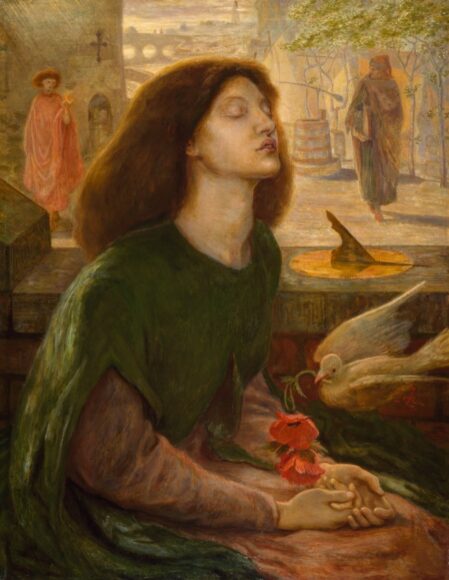
Vision after vision is basically a variation on the theme of the doomed damsel. Dante Gabriel Rossetti’s Beata Beatrix is a portrait of his wife, Elizabeth Siddal, dressed up as Dante Alighieri’s beloved Beatrice. In Dante’s writings, Beatrice dies young. So, in real life, did Siddal, overdosing on laudanum. Putting up with Rossetti would have tested the stability of any partner in love.
The poetry favoured by this tremulous cast of bearded predators is the noisy storytelling they call narrative poetry: the recounting of tragic histories in booming verse and heroic rhymes. Isabella and the Pot of Basil by William Holman Hunt, finished in 1868, is a wall-sized whopper based on a Keats poem that tells of the doomed affair between Isabella and Lorenzo.
Set in medieval Florence, the poem describes how Isabella and Lorenzo fall in love when they shouldn’t. Yup, that old chestnut. Isabella’s brothers murder Lorenzo. So she plants his decapitated head in a pot of basil in her bedroom, where the basil grows lush and tall.
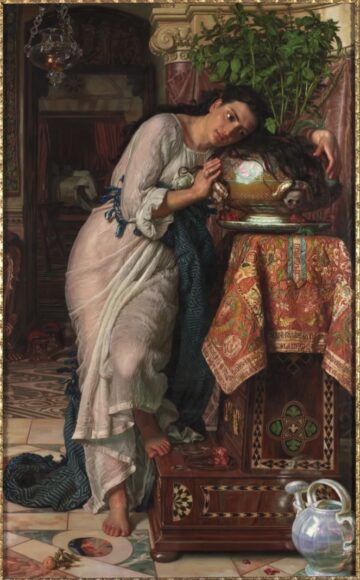
Any sentient painter would have left such obvious nonsense alone. But Hunt goes all in on the tale and shows Isabella in a see-through nightie cradling the pot as if it were Lorenzo and the two of them were hugging. Adding pathos to this unfolding is the fact that the model for Isabella was Hunt’s wife, Fanny, who did indeed die in childbirth in Florence in 1866. So what did Hunt do? He married her sister Edith.
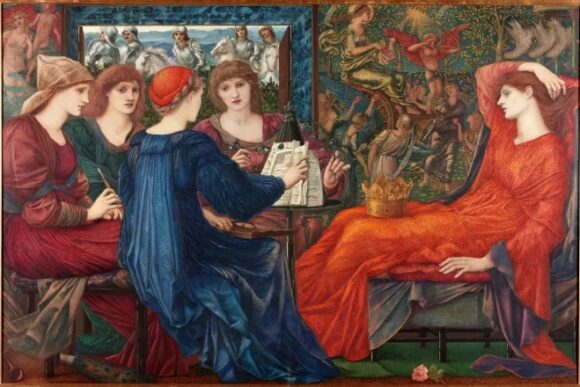
Isabella and her pot belong to the Laing, as does the second picture the show focuses on, Laus Veneris by Edward Burne-Jones, which shows Venus transported again to medieval Italy and dressed in bright crimson while a choir of unhappy celestial virgins sullenly sing her praises. Drooping back in her chair, clutching at her hair, Venus looks as if she has just been told she has cancer.
Painted between 1873 and 1875, it’s another absurd escape into nostalgia: art that’s desperate to turn its back on reality and wallow in the imagined sweetness of a fake medieval age.
Just for context, and to underline how silly this retreat is, here’s a list of things that were invented in the 1870s: the telephone, the phonograph, the incandescent lightbulb, the electric typewriter, the four-stroke internal combustion engine, double-stranded barbed wire, automatic pneumatic brakes and cable cars.
And while all this was going on, Burne-Jones was imagining wispy medieval Venuses.
Pre-Raphaelites: Art and Poetry is at Laing Art Gallery, Newcastle, to Feb 13