Love. It makes the world go round and all that, but in art it’s one of the rarer subjects. Of course, love’s sister topics desire, fertility and sex have had plenty of airing, but that soppy feeling you get when someone floats your boat — the fuzz, the uplift, the light-headedness — is hardly ever recorded.
Why it has been avoided is easy to explain. By and large artists have put their talent at the service of others. Someone else paid, they made the work. But love is untransferable. It’s an emotion that belongs to you. You can’t paint someone else’s love.
So it wasn’t until art became a vehicle of personal expression that amour began to creep into the canon. Not until we get past the Renaissance do we find artists attempting to record their own soppiness.
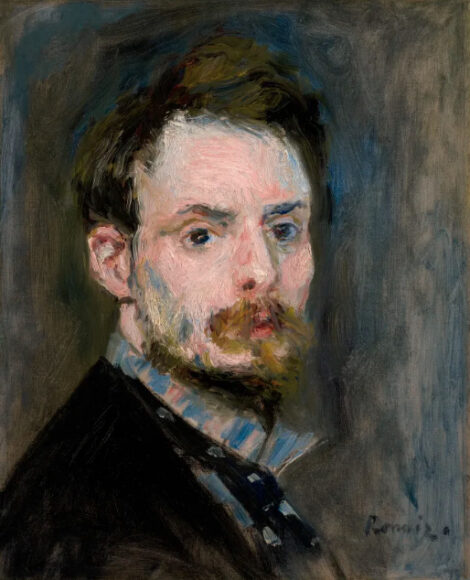
It finally gets an airing in the baroque era — the me-days of the 17th century. I would date the debut to Rubens and his lovey-dovey portrayals of his two wives, Isabella Brant and Helena Fourment. Let’s throw in his kids as well, the first children in art to be tangibly adored by a doting father. The floodgates were opened. Skip forward a couple of centuries and we get to Renoir.
In important ways Renoir and Love, which has arrived at the National Gallery like a fragrant bunch of roses on Valentine’s Day, is a radical show and a brave one. It’s brave because Renoir can almost be considered a cancelled artist these days.
His sexual history causes disquiet. His politics are frowned on. His paintings of women, especially the late ones, are habitually accused of misogyny. A few years ago an artistic pressure group calling itself Renoir Sucks at Painting began picketing American museums, waving placards insisting that “God hates Renoir”. It was jokey, yes, but underlying the sarcasm was widespread hatred.

The disgust has eased a mite. But it hasn’t disappeared. The National Gallery is still tangibly poking the distaff bear with this cocky attempt to present Renoir as a painter of warm feelings, to cheer us up with Parisian sensations of joie de vivre, to persuade the stompers there is artistic merit to his intoxicated pursuit of love.
The opening room gets in quickly with the excuses. In the first caption we learn he came from working-class stock and that this differentiated him from the other impressionists, who were uniformly middle class. With Renoir we’re dealing with some proletarian rough. And the suspicion is sown that his vision was uncouth but truthful.
Excuse No 2 follows swiftly. The opening portrait in an examination of Renoir’s love is of his fellow impressionist Frédéric Bazille. It shows the lanky studio buddy hunched over a canvas that feels much too small for him: he stoops to paint. The technique is swashbuckling and the observations have a cheeky delight to them, like the sudden red of the laces on the slippers Bazille wears to work in. We’re sensing love, but it’s the huggy variety that glues together a pair of studio mates.
Thus Renoir the fierce misogynist is held back from the fray — and finally makes a half-hearted appearance at the end of the opening circle of paintings with a full-length nude of his Parisian mistress Lise Tréhot pretending to be a nymph by a stream.
As an introduction it’s trepidatious: keen not to put a step wrong. The anxiety never disappears fully from the journey ahead. There’s always a sense here of the show looking over its shoulder.
What does not need soft-soaping is Renoir himself. By the time we get to the second and third rooms you would need to be blind not to be impressed by the spectacular painterly qualities being displayed. The sensations of love are unmissable.
Lean into any corner of the bustling tavern views that became his speciality as an impressionist and you will find whispery couples flirting, dancing, drinking, sneaking off. What’s being celebrated is love in its youngest stages: the first excitement. It’s the kind of youthful release people go to Glastonbury for today; in Renoir’s time they piled into the Moulin de la Galette and danced till they dropped.
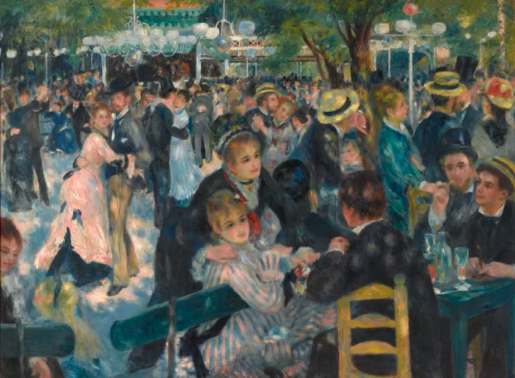
Not only does Renoir pinpoint this carefree mood but his quick painterly hands are fast enough to capture it. In any of his corners you can find exciting evidence of his courage. The skips, the lurches, the twists of his brush as it hurries to record the rush of love are an inventive delight. His touch finds as much joie de vivre in the foliage of a passing tree as it does in the sexy sweep of a girl’s dress.
And there’s a range of tones. He could do love’s uncertainties as well. In a tiny café scene the posh couple waiting to go to the theatre share their stall with a street girl who sits alone. Quelle tristesse. It’s class commentary, for sure, but driving it is what you feel in your heart, not what you read in books.
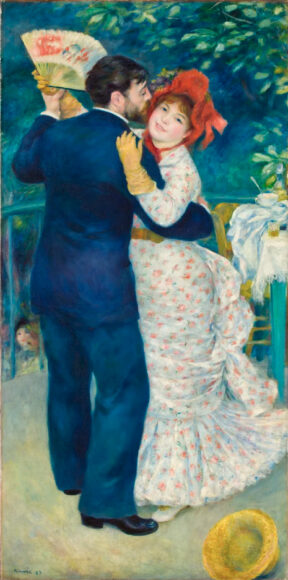
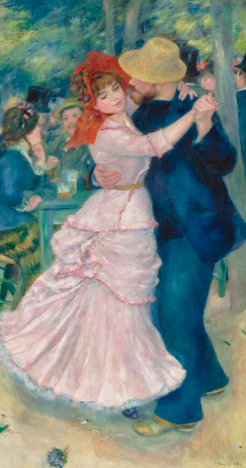
At the centre of the show any remaining doubts disappear as he drenches us in a fierce shower of Parisian pleasure. Two swirling full lengths of dancing couples fill the gallery with music, squeezes and the intimate swapping of gazes. As a record of entwined love with your clothes on, Renoir’s Dance at Bougival will never be improved on. Only at the second inspection do you notice that the woman in the picture is finding the moment more problematic than the man, and may not be sharing it as fully. Sneakily, here and often, Renoir is on the side of the feminine.
All this is good and even great news. The show ahead dips briefly into his expressions of family love — he was passable on toddlers but unpleasantly sticky with children — before arriving, abruptly and a tad nonsensically, at scenes of love in the theatre.
The audible creaking at this point is the sound of the second half of his career being sawn off. We’re in 1885. Renoir did not die until 1919. What we have here amounts to half of his life.
What lies ahead is the bad stuff that people wave banners about, insisting “God hates Renoir”. It’s cruel of the National Gallery to slice him down the middle. But it’s the right decision.
Renoir and Love is at the National Gallery, London, to Jan 31