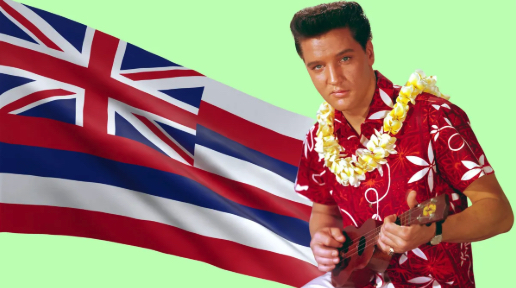
The Hawai’i show at the British Museum is full of unexpected sights, big and small, but what surprised me most was the revelation that the official flag of Hawaii is dominated by the Union Jack. There it is, looming up in the corner, surrounded by matching stripes of red, white and blue — as British a flag as you will ever see.
It’s surprising because Hawaii is the 50th state of America; it’s where Elvis filmed Blue Hawaii and Girls! Girls! Girls!; where surfing was invented; where Steve told Danno to “book ’em” in 280 fabulous episodes of Hawaii Five-O. What in Honolulu’s name has the Union Jack got to do with any aspect of this all-American Polynesian fantasy?
The answer turns out to be a lot. Hawaii, it emerges, has a past interwoven intimately with British fortunes; a past hidden in recent times under the blanket of Americanisation; a past rich with independence and invention. Indeed, so strikingly has America been written out of Hawaii’s story, as related here, that the show feels like the opening conch blasts of an independence movement. “Ho’oku’u Hawai’i,” roars the event, before tailing off into a final sadness.
As always with the British Museum’s explorations of places we know too little about, the tale is told with a mix of exciting artefacts and helpful texts. Greeting us at the door, like an angry nightclub bouncer, is the huge wooden figure of Ku, the snarling 8ft divinity, carved from breadfruit wood, who, I read, “sacrificed his own body in a time of famine to feed his family”. Yikes.
One thing you never get with the gods of Hawaii is a smile or a display of calm. Modelled on nature’s angriest moods, they seem always to speak of thunderstorms and volcanic eruptions, cracks in normality and violent surges. The looming Ku has a presence as gnarled and lumpy as the skin of a crocodile. His mouth appears to have opened in a mighty roar. He’s scary, and the divine tone he sets is a world away from the soft, tiki moods of Elvis’s Hawaii.
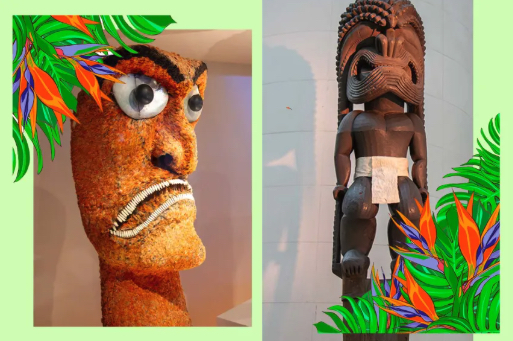
The display ahead is dominated by four artforms: sculpture, bark painting, featherwork and weaving. The opening room forces us to run a gauntlet of Hawaiian gods fashioned inventively from whatever nature could supply. Most are carved from wood. Some are woven. Their eyes are usually inlaid with mother of pearl. The teeth they bare are usually dog teeth, sometimes shark teeth, sometimes the tusks of an unlucky boar.
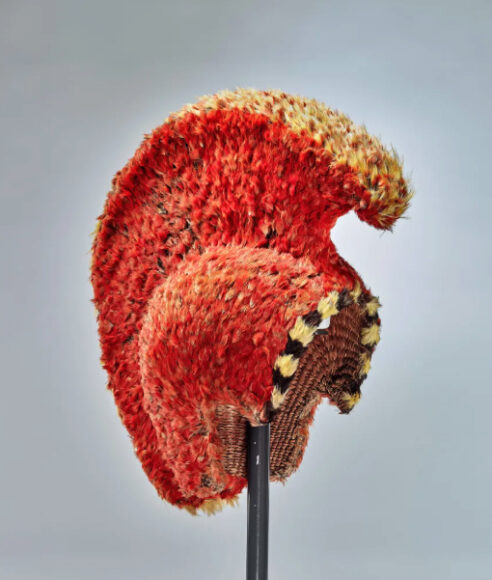
This inventive use of whatever is at hand to make art is always characteristic, and occasionally problematic. As a happy birdwatcher I was drawn immediately to the ceremonial cloaks and lordly headgear fashioned from coloured feathers collected mainly from two tropical species: the scintillating red of the ’i’iwi (or scarlet honeycreeper) and the lemon yellow of the ’o’o ( Hawaiian honeyeater).
The latter is now extinct, its term on Earth cut short by deforestation and the arrival of European hunting rifles. In a show soaked amply with regret at what has been lost, I felt a particular sorrow for the gorgeous ’o’o bird and its gift of precious yellow feathers to all those lordly cloaks and all those royal crowns.
Many of the finest objects here were collected by Captain James Cook, who “discovered” Hawaii in 1778, renamed the archipelago the “Sandwich Islands”, and returned in 1779 to die ingloriously in an altercation with angry indigenous seafarers. As a result of the insatiable collecting spirit of the so-called Enlightenment, the British Museum owns more than 900 precious examples of early Hawaiian art, a holding matched only in Hawaii itself.
Having employed a choice selection of these enviable holdings to establish an alternative Hawaiian mood to the one enjoyed by Elvis in Paradise, Hawaiian Style, the show gets more texty and documentary as it veers on to its main storyline: Hawaii’s tragic relationship with Britain.
It’s a tale of two kingdoms. The fabulous feathered cloaks with the dazzling op art patterns that keep brightening up the journey were made chiefly for the bevy of Hawaiian kings who ruled the archipelago’s many islands. But by 1785, in a pioneering act of Polynesian politicking, King Kamehameha I had united the many kingdoms into one, creating a unified independent monarchy with special ties to Britain.
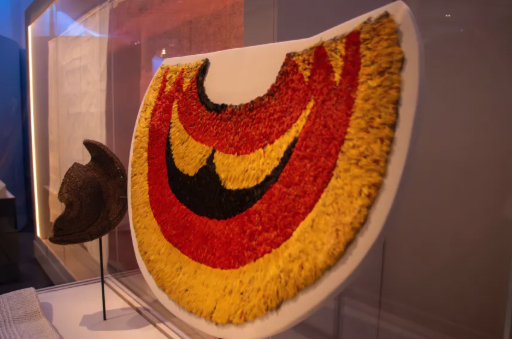
In 1810 Kamehameha wrote to George III requesting protection and support to defend the Sandwich Islands from foreign powers, especially the ever-hungry Russians. The letter is on show here, as is the gorgeous feathered cloak that accompanied it. The Hawaiians clearly had an inflated image of the stature of British royalty as the cloak is so long it would have fitted Ku himself.
But it was Kamehameha I’s successor, Liholiho, who finally set off for Britain in 1823 to seek a formal alliance between the two kingdoms. George IV was on the throne when Liholiho and his queen eventually arrived in 1824, after a five-month sea voyage. A few weeks later the Hawaiian royals were both dead, struck down by measles.
As the century progressed, the clouds over the kingdom of Hawaii grew ever darker. In 1893 a coup orchestrated by a gang of American businessmen overthrew the indigenous monarchy. The last queen, Lili’uokalani, pleaded for British support but Victoria declined, famously declaring that the fate of Hawaii was “in the hands of the Almighty”.
That’s how Hawaii became American. How its history was lost, its culture subsumed. And how the Union Jack came to sit atop the national flag as a perpetual reminder of what might have been.
Hawai’i: A Kingdom Crossing Oceans, is at the British Museum, London, to May 25