When Moses came down from Mount Sinai with the Ten Commandments given to him by God, two in particular would have interested any artists gathered in the waiting crowd. One is the Second Commandment, which says, “Thou shalt not make unto thee any graven image, or any likeness of anything that is in heaven above or in the earth beneath” — in other words, don’t make art. The other is the Sixth Commandment, which insists: “Thou shalt not kill.” Oops. Bang goes another creative favourite.
Murder has proved to be exceptionally popular in art. The act of killing, the way people die, who dies, why they die have been of recurring cultural interest. So much so that the Sainsbury Centre for Visual Arts has decided to make art’s appetite for murder the subject of a rousing investigation.
Housed in one of Norman Foster’s signature buildings, the centre is probably Britain’s wackiest collection of art. Ranging from pre-Columbian sculpture to paintings by Francis Bacon, from African fetishes to Modigliani nudes, it is, like Heraclitus’s famous description of a river, somewhere you can never step into twice because it’s always changing.

Under the director Jago Cooper, this unlikely venue has put on a succession of unlikely investigations of unlikely subjects. Last year it was drugs and their impact on art. Then the sea and all it has inspired. Now, from far out in the left field, comes a show posing the question: can we stop killing each other? To say this event wrestles with this dark ask is mightily to understate the difficulty. This isn’t wrestling. This is full body contact kung fu.
As with all shows at the Sainsbury, the search for murder is a multipart parade that tries its best to hang together but never quite manages it. Scattered about the building in various niches, corridors and galleries, it thrusts hither and thither, looking for interesting things to examine in the killing fields of art.
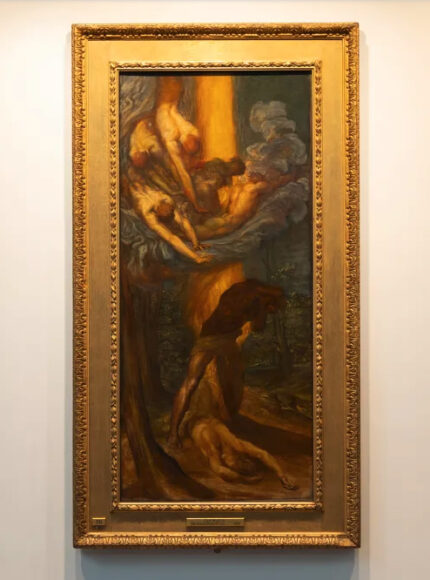
The start, at least, is legible, with a rousing depiction of the murder of Abel by his brother Cain — the Bible’s first assassination — by the thunderous Victorian GF Watts. Part painting, part explosion in a fireworks factory, it’s typical Watts, with scary lighting, glistening flesh and satanic smoke.
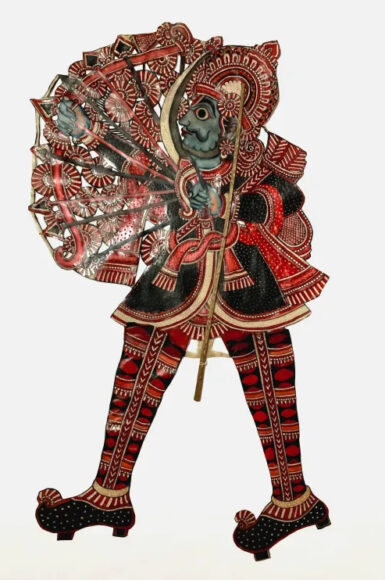
What follows is less certain. Before we know it we are in the world of Indian shadow puppets and Punch & Judy shows, where violent marionettes beat the living daylights out of each other to the evident delight of watching kids. This childish enjoyment of symbolic extinction is, we learn, an international human reaction. A section of Japanese woodcuts confirms the point.
By the time we reach the heart of the show, a lengthy tribute to Shakespeare’s most violent moments, we have learnt that art is a safe space for death, somewhere to rehearse the final darkness. And what a lot of liquidation there is in that Punch & Judy show writ large: the plays of Shakespeare.
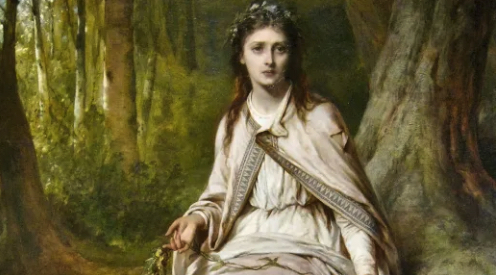
Othello’s fatal jealousy, the deaths of Juliet and her Romeo, the final madness of Ophelia have inspired tremulous art in impressive quantities. The show was unable to persuade the Tate to lend its famous Ophelia by Millais (nor do we have the version by Friedrich Heyser that Taylor Swift picked out in her Fate of Ophelia video) but we do have three other river scenes in which poor, mad Ophelia finds her psychic turmoil symbolised by the twists and knots of the nature surrounding her watery grave.
While all this jumping about from epoch to epoch, country to country, art form to art form, is going on, a set of instructive wall texts ensures we keep abreast of the show’s bigger meanings. Art, we keep being told, is a rehearsal space in which we release our angers and evaluate their consequences. The modern world doesn’t get specific mentions but, like the prompter in a Shakespeare production, it keeps whispering from the wings: “Look at me.”
The mutters are most audible in those moments of the voyage when we’re asked if the levels of violence we see in video games and Hollywood movies have inspired an increase in violence in the real world. To my eyes it’s as clear as crystal that they have and that the school shootings and mass stabbings are the direct result of a continuous barrage of blam, blam, blamming on the teenage mind. If it were up to me, I would ban all violent video games.
But, of course, there’s mass money to be made in mass murder and the games companies would quickly find another way to exploit our bloodlust. It’s a point made with startling ferocity by Crossfire, a film installation by Christian Marclay, which I nominate as the show’s masterpiece.
Combing the world of movies for instances of people shooting each other, Marclay has woven the countless examples he collected into a ballet of assassination taking place on four screens that surround you. We start with a gun being loaded. Progress to the first shootout. Pause for a reload. Then all hell breaks loose.
Bullet after bullet, angry face after angry face, from war pics to gangster movies, from westerns to sci-fi shootouts, from Clint Eastwood to Arnold Schwarzenegger, blam, blam, blam go the revolvers, rifles and machineguns, with us in the middle. The relentless gunfire builds to a hypnotic pattern, until its insistent rhythms become perversely attractive.
This Cain instinct is being triggered. And the world is suddenly full of listeners.
Can We Stop Killing Each Other? is at the Sainsbury Centre, Norwich, to May 17, 2026