Peter Doig. Whenever I see the name I hear the rustle of dollar bills and the jingle jangle of a big win on the slot machines. To my mind, Doig’s art — which fetches up to $40 million a painting — has become synonymous with fiscal success, and even interchangeable with it.
However, his new show at the Serpentine Gallery offers an alternative to these mean preconceptions, and fights against them. Before we get in there to enjoy it, it is instructive, I think, to remember why he became so successful.
His main achievement, and it’s a huge one, was to repopularise painting. Because of him, the simple pleasure of buying something you can hang on the wall became fashionable again. I’ll spare you the detailed background to these silly events and ask only that you recall how unfashionable painting was in the Eighties, Nineties and early Noughties. In the epoch of conceptual art, painting was anathema.
Doig was not the only reason that changed, but he was the change’s poster boy. What he offered — and this was a great trick — was old-fashioned artistic pleasures that could be understood in new-fashioned ways. His interest in black culture, his residence in Trinidad, the multicultural range of his references, made him so impeccably progressive that the art world forgave him the painting bit. And once those gates were reopened, out surged half a century of pent-up pictorial creativity.
So that’s why he’s important. But it’s not why his show at the Serpentine is such a joy to wander through, taking in the vibes. Indeed, the perverse thing about Peter Doig: House of Music is that it constitutes a turning of the back on pure painting and functions mostly as an ambitious installation. So much so that I find myself remembering the ambience more clearly than most of the pictures scattered about it.
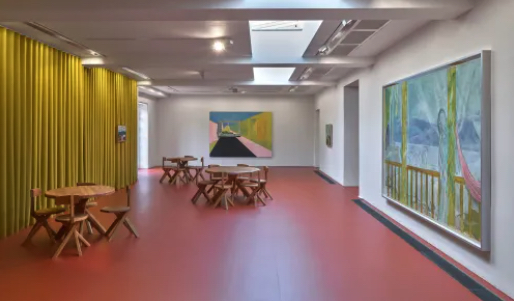
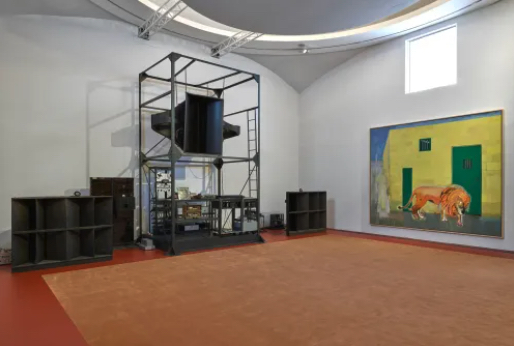
The gallery has been turned into a loose mock-up of a domestic interior. The four rooms of the show could be someone’s house, with a terracotta floor, a terrace where you can sit at night and watch the stars, and a living room with the biggest speakers you’ve ever seen blaring out music at the punchiest of volumes. All that’s missing to complete the pleasure — and I’m projecting crazily here rather than remembering a lived experience — is a big spliff of Trinidadian ganja to accompany the throbbing basslines.
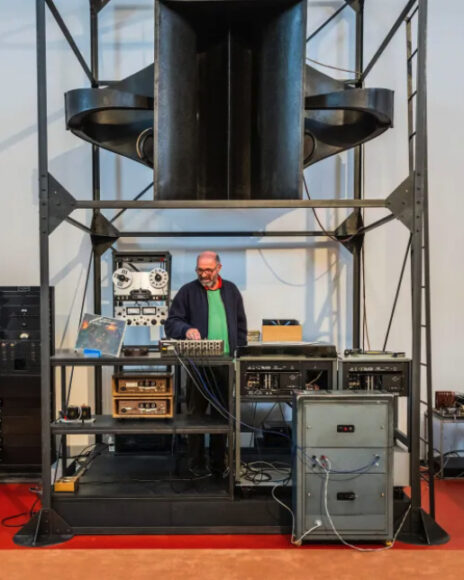
The music side of this atmospheric feng shui is the handiwork of Laurence Passera, a hi-fi nut who restores the giant speaker set-ups that used to power the sound in Britain’s early cinemas. Passera tours the country rescuing fabulously gothic sound systems that look like props from a Gotham City movie. Dotted about the show, they are striking to look at and powerful to listen to.
Where most mock-ups of domestic interiors would point us to the tastes and ambitions of a single owner, this one has a strong communal sense, more youth club than mansion, with one room set up for café snacks and playing cards, another for sitting together outside, listening to the strummings of an old calypso player, and enjoying the twinkle of the lights on the far bank of the harbour. I’m fantasising madly. It’s that kind of show.
In fact, the fantasies are being directed, subtly, cleverly, by Doig’s paintings. In the “dark” room, which the artist has filled with low-slung wooden chairs imported specially from Trinidad, there really is a twinkling harbourscape on the longest wall, set at night and illuminated magically with café lights. You really could be gazing across at it, taking in the stars.
As for the strumming calypso player, he’s there as well, in a painted portrayal, old and dapper, twanging tunes out of a beaten-up ukulele. Thus the paintings add layers of detail to an experience that takes place mostly in your imagination. The music and the art have combined to create a transportive gallery moment that feels like a Caribbean journey, but which actually involves staying put.
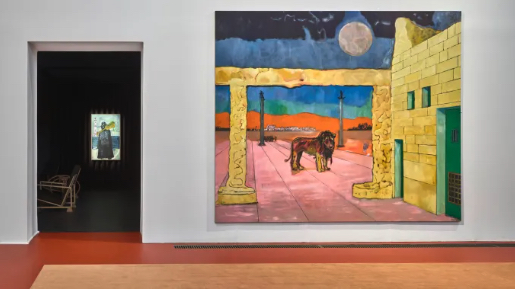
The sense of being in an installation in which the paintings are almost incidental, a glimpse through a window, disappears in the exhibition’s central space, the aforementioned spliff-demanding mock living room. Here, a suite of huge canvases involving a lurking lion separate the space from the other interiors and demand to be looked at in picture terms. They’re too big and heraldic to constitute a glimpse.
The first one has the lion prowling past a bright yellow prison, with barred windows, and an island lighthouse in the distance. On the opposite wall, the lion is back, but seems this time to be in Venice, with the imprisoning yellow building on one side and the unmistakable columns of St Mark’s Square commanding the central vista.
What’s going on? I won’t make the mistake here of trying to solve the riddle. In Doig’s art, there are no solutions. He’s a supplier of ingredients who leaves you to devise the recipe. But the title of one of the cat paintings, Rain in the Port of Spain, locates us firmly in Trinidad, where the Lion of Judah is a ubiquitous Rastafarian presence and where issues of captivity, historic slavery and displacement from Africa swirl unavoidably though the air like the smell of ganja.
Without mentioning slavery or captivity or Africa, Doig’s paintings turn the show towards a historical darkness. That’s how he works. That’s why he commands the big bucks. That’s why he made painting fashionable again.
Peter Doig: House of Music is at the Serpentine Gallery, London, to Feb 8