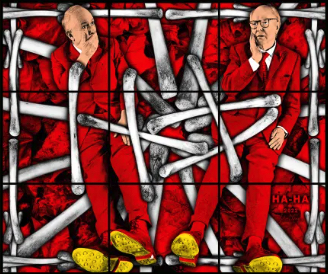
Two veteran artistic presences have appeared in London simultaneously. Both have been around the block many times. One remains fresh, active, naughty. The other has grown tired, repetitive, boring. Let’s deal with the tedious one first. Let’s deal with Gilbert & George.
In the Sixties, when they were in their twenties, the two Gs were messing around together doing silly things and lecturing us on the importance of tolerance. Now that they are in their eighties they are still messing around doing silly things and still lecturing us on social tolerance. These days, however, it’s like being stuck in the snug with the pub bore.
Their problem is verbosity. Optimistically entitled 21st Century Pictures, their show at the Hayward Gallery has filled every space in the building with relentless quantities of formulaic G&G art that goes on and on and on. By the second gallery the walls feel as if they are closing in on you and you find yourself gasping for air.
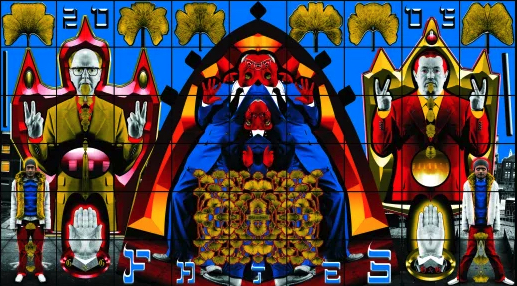
Since they went digital and stopped working with real photographs, G&G have been producing what we might call digital stained glass windows: brightly coloured squares of imagery combined digitally into multipart rectangles that feel vaguely churchy and have a symbolic mood to them. And, of course, they always squeeze themselves into the pictures too, like a pair of narcissistic Hitchcocks.
The subjects have also atrophied. The same G&G themes are visited and revisited up and down the Hayward. Most often they attack religion, especially Islam and Christianity, for policing sexuality. (“Prick-tease a Priestess,” screams one bit of advice. “Shag a Sacristan,” says another.)
When they are not mooning the church, they highlight the squalor of the East End, where they live, and by extension modern values. A collection of shouty newspaper headlines gathered from the London Evening Standard (“Vicar fights brothel closure!”) offer pointy evidence of the mush into which tabloid thinking has reduced our brains.
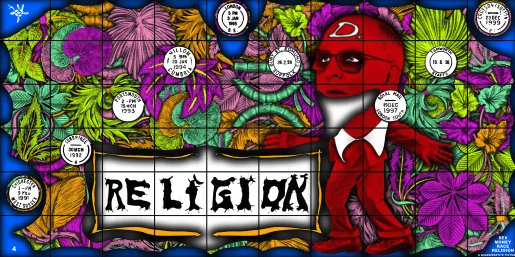
The problem with these preachy lists is not that they are necessarily wrong. They are not. The problem is that going on and on about the same stuff in the same way without evolving the aesthetics or branching out somewhere fresh makes for an unpleasantly claustrophobic experience. If the Hayward had windows you would be desperate to throw them open.
That said, even a pub bore can have something interesting to say now and then and the repetitive art methods they employ cannot stop the occasional flash of invention showing through. In particular, the fact that they are so old now, tangibly in touch with their mortality, has allowed a poetic melancholy to creep into their digital world and expand it.
Most poignantly, the bones left over from a discarded takeaway found in the street make several doomy reappearances in a set of self-portraits that tremble with fragile awareness of the opening hours at the pub. Drink up, folks. It’s time.
Where the Gilbert & George show at the Hayward smells musty and in need of air, the art of Matthew Collings at Handel Street Projects jumps about frantically like a flea with ADHD. Never pausing long enough on any of its many subjects to feel formulaic, it’s one of those rare art displays that feels as if it’s doing something art has never done before in ways that have never previously been tried.
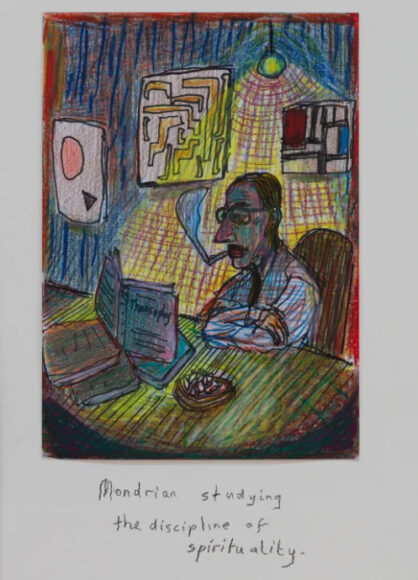
Like G&G, Collings, 70, has a long past. Unlike G&G, he has used it adventurously to re-invent himself. Starting out as an artist, he became a critic, then a bestselling author, then a TV personality, then a critic again, and now that being a critic is no longer a viable option because everybody fancies themselves as one of those, he has gone back to being an artist — with brilliant results.
It started during Covid with an enterprising effort to keep afloat by selling work on Instagram. That necessitated the production of a torrent of drawings in super-quick time that could then be sold cheaply and quickly. Many tried it but no one as successfully as Collings. The years of multiskilling that preceded his reinvention as an artist had filled him up with topics, experiences and knowledge. The sudden opportunity offered by Covid allowed all that to come flooding out of him in a wild and exciting rush of thoughts and images.
The Handel Street show has hundreds of examples tacked on to its walls and none of them constitutes a repetition. There’s fiery art history, fiery politics, fiery psychology, twisted into whimsical inventions by what is probably a certifiable case of madness. The best of the crazy outpourings are invented scenes in which celebrated figures from the past, mostly artistic, but not exclusively, are “Tardis-ed” into the present and forced to meet each other like dream guests at a dinner party.
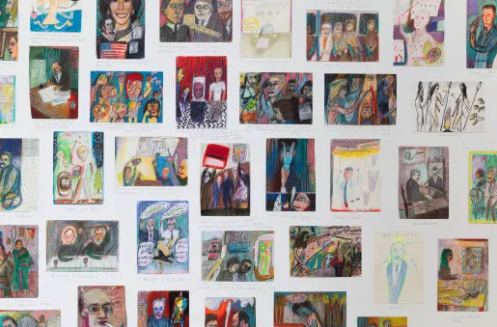
Thus Tintoretto finds himself sitting next to Frank Auerbach. Hitler mends his ways after a spiritual encounter with Hilma af Klint. Andy Warhol pops up at an orgy with Jesus Christ and Mary Magdalene.
There’s a cartoonish air to these brilliantly contrived ensembles — every second image had me laughing loudly — but also recurring notes being struck of sadness and lament: a longing for the days when art was something crucial that meant something deep. There is no livelier show displaying in the capital. I hope it gets nominated for the next Turner prize.
Gilbert & George: 21st Century Pictures, Hayward Gallery, London, to Jan 11; Matthew Collings Holistic Art Experience, Handel Street Projects, London, to Oct 24