Two shows. One big, one small. One in Amsterdam, one in London. Both concerned with the mad things you see when reality is pulled out of true, played with, distorted. A pair of shows, therefore, that feel very on message, given the present state of the world.
The big show is at the Rijksmuseum in Amsterdam and devoted to Metamorphoses, the epic poem by Ovid, which must be the second most illustrated text in art after the Bible. Written in Rome in the 1st century, Metamorphoses has triggered countless depictions by fascinated artists — and continues to do so.
Ovid’s dodgy storylines about the loves of the gods, packed with sex, betrayal, jealousy and torture, have proved as unkillable as a cockroach. To underline their pertinence the Rijksmuseum’s entertaining display mixes the old with the new. Titian is here and Caravaggio. So are René Magritte and Louise Bourgeois. Thus the twisty Roman fantasies are transported from then to now, where they sit with uncomfortable comfort. Any society with divisions between rulers and servers, haves and have nots, celebrities and wannabes will find something to gawp at in the spectacularly dissolute Metamorphoses.
We begin with Chaos. Literally. According to Ovid, the world started out as “rudis indigestaque moles” — a raw, unordered, shapeless mass — until a higher force brought order to the disorder by separating Earth from heaven, sea from land, air from sky. So the muscular Victorian fantasist GF Watts gives us a particularly wide depiction of a gaseous nothingness becoming a molten somethingness with figures crawling out from beneath molten rocks and emerging from the fires (1875-82). While the darling of feminist reappraisal Ana Mendieta shows a female figure with a volcanic vulva at its centre, solidifying slowly in a pool of mud (1981).
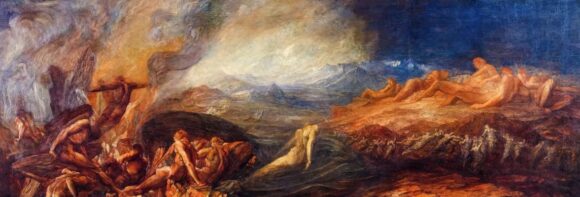
But Chaos wants always to return to its primal state. And underlying Ovid’s action-packed progress is the suspicion that the order is temporary. In this, and in much else, history has proved him to be comically insightful.
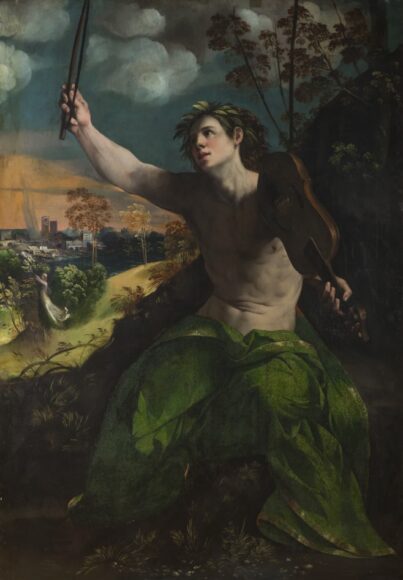
A large chunk of the fun in Metamorphoses is devoted to the unequal loves between gods and non-gods. Cupid and his dangerous arrows are a constant source of disorder and transformation. In the story of Apollo and Daphne, the beautiful nymph is saved from the dangerous god by her father, who turns her into a tree. The single best representation of this magic moment is by Bernini in his marble masterwork at the Galleria Borghese in Rome, where this show is travelling next. In this Amsterdam edition the transformation of flesh into wood is depicted less miraculously, more calmly, by Dosso Dossi and Nicolas Poussin.
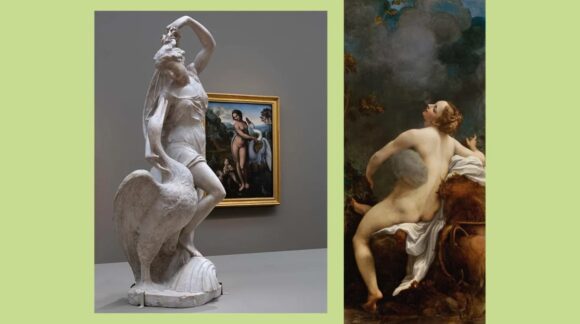
When it comes to sexual predation, no one in mythology has behaved as alarmingly as Jupiter, the king of the gods. A divine amalgam of Weinstein and Epstein, the uncontrollably lustful Jupiter adopts wicked disguises to pursue his unfortunate victims. To seduce Leda, as painted by Leonardo and Michelangelo, he disguises himself as a swan, his long neck standing in perfectly and creepily for the penetrative penis. In pursuit of Danaë, as painted by Titian, he descends to Earth in a shower of gold that falls on to the unsuspecting loins of the rapt princess. To rape Io, as depicted brilliantly by Correggio, he turns himself into a fog, so the poor nymph does not even know she is being secretly forced.
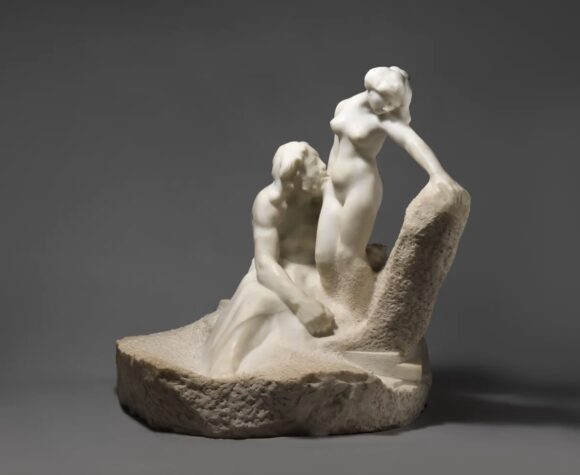
Among the show’s many strengths is the range of methods and materials it includes in its examples. The vain Narcissus stares lovingly at his own reflection not only in Caravaggio’s famous painting but also in a gorgeous French tapestry of the 15th century. The Pygmalion myth, a recurring Ovidian favourite about the sculptor who creates a female statue so realistic that he falls hopelessly in love with it, is described smuttily in stone by Rodin and spookily in paint by Delvaux.
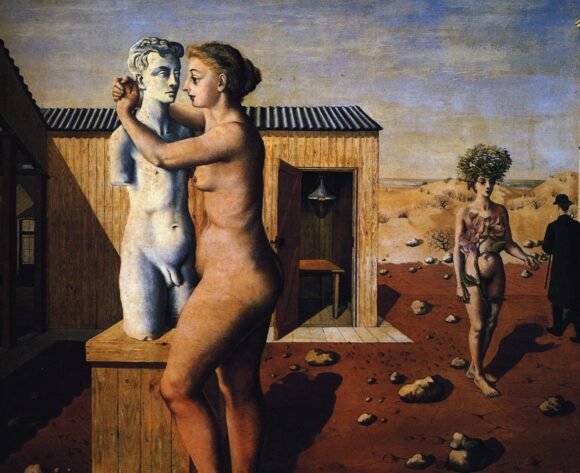
Keeping up with Ovid’s nutty storylines demands constant invention from the show’s diverse cast of artists. The story of Arachne and Minerva climaxes with the angry goddess turning the boastful mortal into a spider, inspiring Bourgeois to create a giant metal tarantula that greets visitors with a sinister hiss you can sense but not hear. Medusa with her head of serpents is implied in miraculous marble by Giusto Le Court (c 1670) and in a snakeish video by Juul Kraijer (2019).
The show concludes with some taut summaries of art’s continuing delight in transformation. That famous penis plate from the Ashmolean in Oxford, featuring a face made of dicks, has been included, as have the anthropomorphic heads of Arcimboldo. In life, Ovid says, putting his finger immovably on the human pulse, nothing is fixed except unfixedness.
In London, in the small show Against Nature, the British painter Georg Wilson gives us a reduced version of these huge conundrums. In her spooky envisionings nature is always in flux and darkness is always lurking.
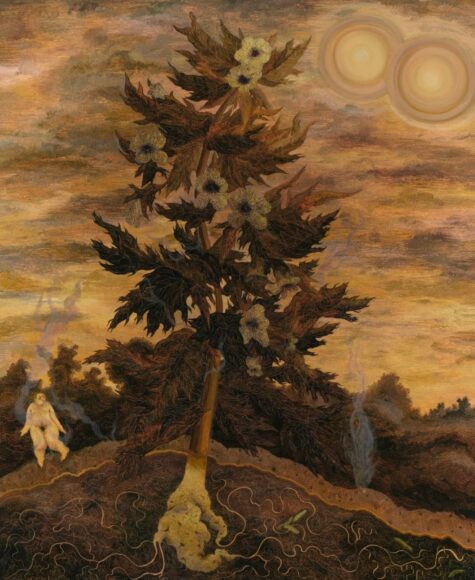
Inspired by the crazier end of the English landscape tradition — Samuel Palmer, Richard Dadd, Ithell Colquhoun — Wilson plunges us into the strange worlds that exist beneath our feet where the vegetation has grown cancerous and dangerous, and weird little munchkins hide among the flora waiting for their moment.
It’s a Day of the Triffids reality in which nature, seen for so long as a balm and a restorative by the English landscape imagination, has become a wriggling biomass of tendrils, thorns and carnivorous suckers. Our Earth, it seems, is returning to its opening condition of Chaos, exactly as Ovid predicted.
Metamorphoses is at the Rijksmuseum, Amsterdam, to May 25; Against Nature is at Pilar Corrias, London, to Mar 7