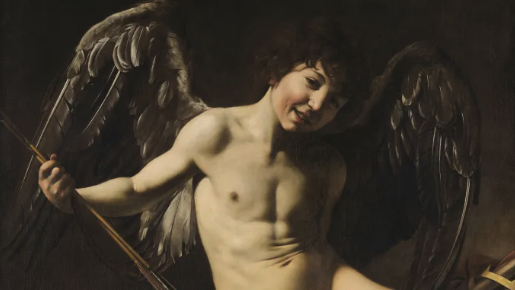
Startling. That’s the word that best describes the impact of the single painting by Caravaggio from which the management at the Wallace Collection has fashioned a dramatic, unsettling and richly engrossing exhibition.
Painted in Rome in about 1601, Caravaggio’s Victorious Cupid shows a naked boy, aged about 12, balanced precariously on a messy heap of still-lifes. So precariously that he ends up pointing his undeveloped manhood at us with uncomfortable directness.
To further complicate these complications, attached to his back is a wonky pair of bird’s wings and in his hand he holds some arrows and a bow. Thus we know immediately that in the symbolic Esperanto of art he must be Cupid, the god of love. But gods are meant to live on high and reign over us from a spiritual domain. This displaying street urchin looks as if he works for Fagin in the daytime and prowls the alleys of Soho at night.
So what’s really going on here? Are we right to suspect the worst of Caravaggio and his notorious sexuality? Is this prepubescent portrayal as wicked as we contemporaneously imagine? Are the laws of decency being flouted? Should someone call the police? No, no, no and no.

What’s really happening is that Caravaggio, in one of his recurring moments of genius, has cancelled Valentine’s Day and is throwing the roses out of the window. Instead, he’s presenting love as a wilful force that can destroy civilisations, topple kingdoms, threaten peace and fill your life with chaos. “Roses are red, tulips are gold, love is a monster, that can’t be controlled.” Put that on your Valentine’s card.
The painting was commissioned by Vincenzo Giustiniani, a famed 17th-century collector whose palazzo in Rome, the Palazzo Giustiniani, was located opposite the church of San Luigi dei Francesi, where Caravaggio scored his first great religious success with his tremendous telling of the story of St Matthew.
When he painted his Cupid he was still transitioning from his naughty boy phase, when the boozing Bacchuses and effeminate lute players who had brought him his Roman fame had formed a cast of divine delinquents whose pursuit of louche pleasures was a new subject in art. The Victorious Cupid is a late addition to their ranks.
Giustianini’s palazzo was filled with a huge assortment of treasures from all the Roman ages, and especially rich in classical statues: Venuses, Apollos and Cupids. Its interior is evoked at the Wallace with a photographic mock-up of Giustiniani’s holdings that feels a mite desperate, as if they had to find something else to plump up the exhibition. But the alley of pretend statuary does at least provide an alternative to Caravaggio’s approach. His Cupid is strikingly tangible. The classical Cupids were not.
Having got the foreplay out of the way, the show confronts us with its great prize, set in darkness at the end of the room, a light at the end of the tunnel. When Giustiniani’s collection was sold off in the 19th century, the Cupid ended up in Prussia. It now hangs in the Gemäldegalerie in Berlin, where it looks nowhere near as potent as it does here: singled out, spotlit, borderline scary.
Its arrival at the Wallace Collection is a typical act of whimsy by the director, Xavier Bray, who is renowned for his invention and seems temporarily to have forgotten that the Wallace usually provides a home for the frilly dreams of the French rococo, not the sweaty and disruptive imaginings of Caravaggio.
Set in virtual blackness, the wayward god of love has gained considerably in three-dimensionality. From a distance, he could be a twisting body in a dark niche. His present title is Victorious Cupid, but I first knew him by his Latin name of Amor Vincit Omnia, which translates as “love conquers all”. It’s a quote from Virgil’s Eclogues and is often represented in art by Cupid riding a sea monster. Even the wildest terrors of the ocean can be tamed by love.
The model for Cupid was said to have been Caravaggio’s young pupil, Cecco. He was certainly somebody real. And while his skinny body is described with uncomfortable exactitude, what really glues you is the expression on his face. He’s so obviously a scamp. The boy in the class who flicks the chewing gum. The disruptive kid who these days would be diagnosed with ADHD.
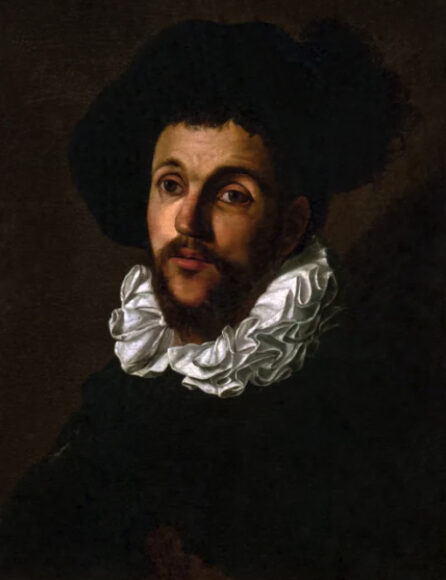
Having punctured the Cupid myth, Caravaggio lets the still-lifes in the picture develop the story. A selection of musical instruments, their strings broken into uselessness, lie in a heap on the left. So do some architect’s drawing materials. By Cupid’s feet there’s a suit of discarded armour and a laurel wreath representing peace. At the back are some royal accoutrements, a crown, a sceptre. Where other Cupids fill the world with poetic love, this uncontrollable rascal tramples on music, on poetry, on theatre, on everything. If you’ve ever taken a wrong turn in pursuit of amore, you’ll recognise the warning.
From a solo painting to a pair of Vermeers… Or are they?
At another of London’s enviable old master collections, Kenwood House on Hampstead Heath, the curators have gone up a picture and created a two-painting show. Both are said to be by Vermeer, and, to complicate matters considerably, both feature the same image. Nearly.

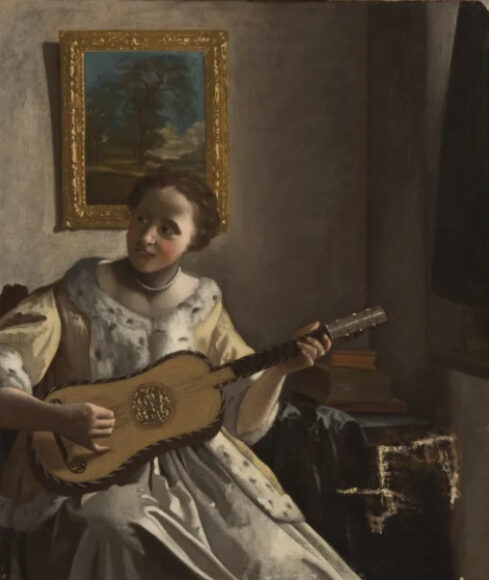
If you know Kenwood you will know that Vermeer’s The Guitar Player is one of its chief treasures. It shows a girl gently strumming and smiling at us mysteriously. Uniquely in Vermeer’s oeuvre, there’s another version, belonging to the Philadelphia Museum of Art. The two have now been brought together for an intriguing comparison.
Having darted backwards and forwards between the two, my conclusions are: the Kenwood picture is definitely superior; the Philadelphia version is probably not by Vermeer; both pictures could be secret evocations of St Cecilia, the patron saint of music.
Caravaggio’s Cupid, at the Wallace Collection, London, to Apr 12; Double Vision, Vermeer at Kenwood, at Kenwood House, London, to Jan 11